
You’re double-selling
🥲Your TikTok Shop ROAS is enormous. That's the problem, Google's latest updates favor the best answer, not the biggest site, and more!
Hey there Smarty 👋
Are you geared up to catch the latest and greatest in quick shorts?
And just a quick heads-up! If you stumbled upon us through a friend, make sure to subscribe here! That way, you’ll never miss out on the trending shorts.

🥲 Your TikTok Shop ROAS Is Enormous. That's The Problem.
GMV Max is efficient at finding people who will convert. What the dashboard does not tell you is that a significant portion of those people were already going to buy through your email list, your retargeting pool, or your owned channels.
The algorithm cannot exclude existing customers because TikTok Shop does not allow targeting exclusions. It finds the easiest conversions available and reports them all as wins.
The brand pays twice. Once in affiliate commission. Again in the slow conditioning of customers who now expect a discount code before completing a purchase they would have made at full price six months ago.
The audit that shows you the real number:
Pull your email and SMS-driven purchase rate from the 90 days before TikTok Shop activity ramped up. Compare it against the 90 days after. The drop in owned-channel revenue is the cannibalization tax.
TikTok Shop revenue minus that tax is your actual incremental lift. For most brands the gap between reported ROAS and incremental ROAS sits somewhere between 40 and 70 percent. The dashboard was not lying. It was measuring the wrong thing.
The affiliate screen most programs skip:
The affiliates producing the highest reported ROAS are usually the ones running the most discount-dependent content, because that is exactly what GMV Max rewards. Pull the last 20 posts from every applicant before approving them. Tag the percentage that lead with a discount, coupon, or urgency-based price hook.
Anything above 40 percent gets flagged. High reported conversion rate from a discount-heavy affiliate is not a signal to approve them faster. It is a signal that they are converting your existing demand at a margin cost while training your buyers that your brand lives in the deal economy.
Modash is hosting a free 3-hour session tomorrow with brand-side teams from Moroccanoil, Edelman, and L'Oréal on the criteria that separates creators who build brand equity from ones who extract it. You can secure your free spot here.
The fix most affiliate agreements do not include:
Content guardrails. Most agreements specify deliverables, timing, and payment terms. Almost none specify that discount-led hooks, urgency tactics, and price-framing language are not permitted. Add them. Enforce them with a quarterly review of every active affiliate's last 20 posts against the original approval criteria.
The reported ROAS is a one-quarter number. The discount conditioning is a five-year problem.
Together with AirOps
AI search doesn't wait for teams still figuring out prompts.
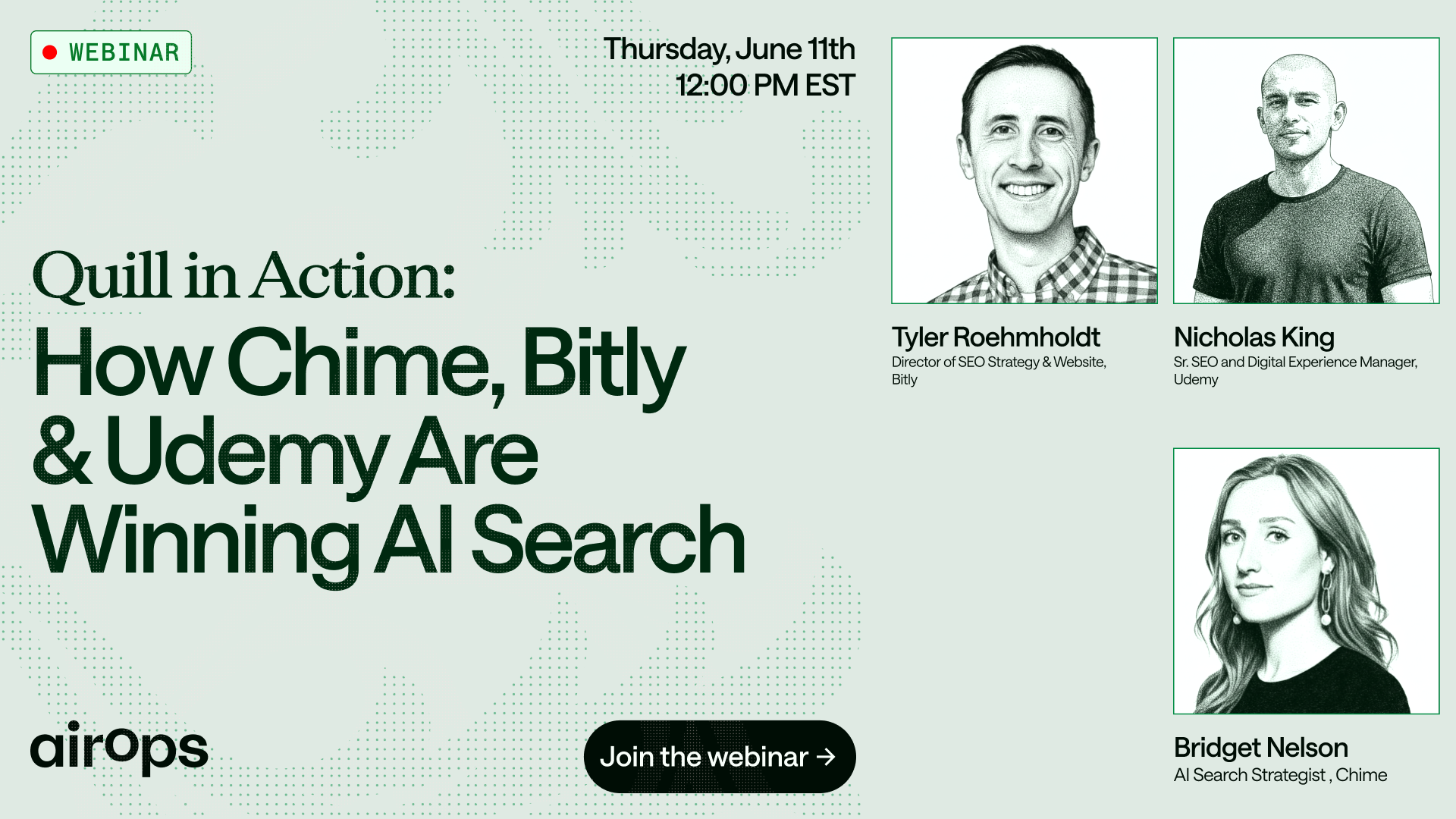
The shift from traditional search to AI search happened fast. What didn't follow was execution. Most teams are still figuring out the workflow while their AI search visibility slips.
Tomorrow, SEO leaders from Chime, Bitly, and Udemy are showing exactly how they use Quill to move past one-off prompts into agentic Playbooks that execute and scale without manual intervention.
You'll walk away with:
- What to say to leadership to get AI initiatives approved fast
- What's working in AI search right now, straight from teams doing it at scale
- Where to start with agentic Playbooks and what to prioritize first
Tyler Roehmholdt (Director of SEO Strategy, Bitly), Nicholas King (Sr. SEO and Digital Experience Manager, Udemy), and Bridget Nelson (AI Search Strategist, Chime) are walking through what they've built and what's moving the needle right now.
One session. A system you can start building the same week.
Can't make it live? Register anyway and get the recording in your inbox within 24 hours.
🤖 Bots take over while Google reshapes search
Cloudflare and Google both highlighted major shifts in how the web works this week. AI agents are now generating more web traffic than humans, while Google's latest search updates continue rewarding pages that best match user intent rather than relying solely on authority.
The Breakdown:
AI traffic reaches a major milestone - Cloudflare CEO Matthew Prince revealed that bots now generate 57.3% of global webpage requests, surpassing human traffic years earlier than expected as AI agents increasingly browse the web on users' behalf.
Intent matters more than authority - SEO analyst Aleyda Solis found that Google's May Core Update favored pages that closely matched a query's intent, market, and result type, even when larger, more authoritative sites were competing.
The right destination won visibility - Some major sites such as NYTimes and NIH lost rankings, while original sources, local retailers, and country-specific domains gained visibility when they better matched what users were actually looking for.
Official guidance remains the benchmark - Google published new documentation reminding marketers that third-party SEO tools do not have access to internal ranking data, warning against services claiming to be approved, endorsed, or guaranteed to improve rankings.
AI agents are becoming a primary source of traffic, while Google's ranking systems are getting better at identifying the most appropriate destination for a search rather than simply rewarding the biggest or most authoritative website.
👨💻 Quick Hits
🧠 Meta will start using off-platform activity data shared by advertisers and websites to personalize Feed recommendations and Meta AI responses, giving its AI deeper context about users’ interests, purchases, and browsing behavior.
📉 A CCDH report found that after Meta loosened moderation policies in 2025, abusive comments toward U.S. politicians surged, with violent threats up 4×, hate speech up 4×, and harassment more than doubling on Facebook.
📉 Google zero-click searches reached 68% in early 2026, up from 60% in 2024. AI Overviews now appear on over 20% of searches and can reduce click-through rates by nearly 60%, keeping more users within Google’s ecosystem.
📹 Snapchat says its Commercials video ads drive 24% higher long-term sales lift than other non-skippable formats. The study also found Snapchat ads deliver stronger attention, brand recall, and lower CPMs, making them more cost-efficient for branding campaigns.
💃Events
🔥 L'Oréal's Former Global Communications Lead Is Explaining the High-Reach Low-Trust Trap Live
Tomorrow | Virtual Event | Free
Eric Ford spent years managing creator relationships at one of the most influential beauty brands on the planet. This session, he's breaking down the reach versus trust tradeoff that quietly derails most influencer programs and how his team learned to navigate it.
✅ Reserve Your Free Spot
Can't make it live? Register anyway, you'll get the recordings within 24hours.
🔥 What a Marketing Org Looks Like When AI Actually Runs It. Chime, Bitly, and Udemy Show You Live.
Tomorrow | Virtual Event | Free
What three real marketing teams are built and running right now? Tyler Roehmholdt, Nicholas King, and Bridget Nelson are on stage showing the exact systems behind their orgs and the moment everything started compounding.
✅ Reserve Your Free Spot
Can't make it live? Register anyway, you'll get the recordings within 24hours.
That’s a wrap for today! Tell us your thoughts about today's content as we line up more Shorts! And don’t hesitate to share this with someone who’d adore it. 🥰