
Your reporting join breaks this month
⚙️ Google auto-migrates campaigns to AI Max across September. The UI looks fine; the data pipeline underneath quietly doesn't, Shoppers want AI to help them buy, but not sell to them, and more!

Hey there Smarty 👋
Are you geared up to catch the latest and greatest in quick shorts?
And just a quick heads-up! If you stumbled upon us through a friend, make sure to subscribe here! That way, you’ll never miss out on the trending shorts.

⚙️ Google is migrating your campaigns this month, and your reporting join breaks quietly
Between September 1 and 30, Google is automatically upgrading two kinds of Search campaigns to AI Max: those using campaign-level broad match, and those using Automatically Created Assets.
The migration rolls out gradually across the month, campaign IDs survive, and once a campaign moves there's no path back. Google says the upgraded settings mirror the old ones closely, and for the person clicking through the Ads UI, that's mostly true.
The problem sits one layer down, in the data pipeline most teams never check until something breaks.
AI Max changes the reporting structure underneath those campaigns: new segments, a new report view, and a change to how landing-page URLs get recorded that can silently break any join a warehouse or BI tool uses to connect ad data to on-site behavior. A campaign that looks fine in the Ads dashboard can be feeding a broken row into every downstream report.
Enumerate the affected campaigns now, while the population is still frozen
Google stopped allowing creation of new broad-match and ACA campaigns on August 3, so the set eligible for migration is fixed and can be listed today. It won't grow.
Pull every campaign still using either setting and mark it as a migration-path campaign before its number gets swept into a blended report next month. A team that can name which campaigns moved, and when, can separate a real performance change from a migration artifact. A team that can't will be guessing in October.
Set a clean pre-migration baseline before the switch flips
Once a campaign is on AI Max, comparing its September performance to August isn't a clean read, since query matching and asset generation both changed underneath it in the same window.
Capture a pre-migration snapshot for every affected campaign this week: conversion rate, CPA, and the query mix it was matching. That baseline is the only way to later tell "AI Max changed performance" from "September was just a different month," and it can't be reconstructed after the migration runs.
Watch the claim gap yourself instead of trusting either number
Google reports AI Max delivering roughly a 7% conversion lift at similar CPA. One independent test across 250+ retail campaigns reported a 35% ROAS decline instead. That's a wide gap between a platform's own figure and one outside measurement, and neither is a substitute for your own account's data.
Tracking query-level visibility and performance across search and AI surfaces in one place, so a migration artifact doesn't get mistaken for a real shift, is what Semrush One is built to surface. You can see how it works here.
The migration is happening on Google's timeline regardless. Whether you can still read your own reporting afterward is the part you control this week.
Together with AirOps
What 300+ Marketing Leaders Are Changing Now
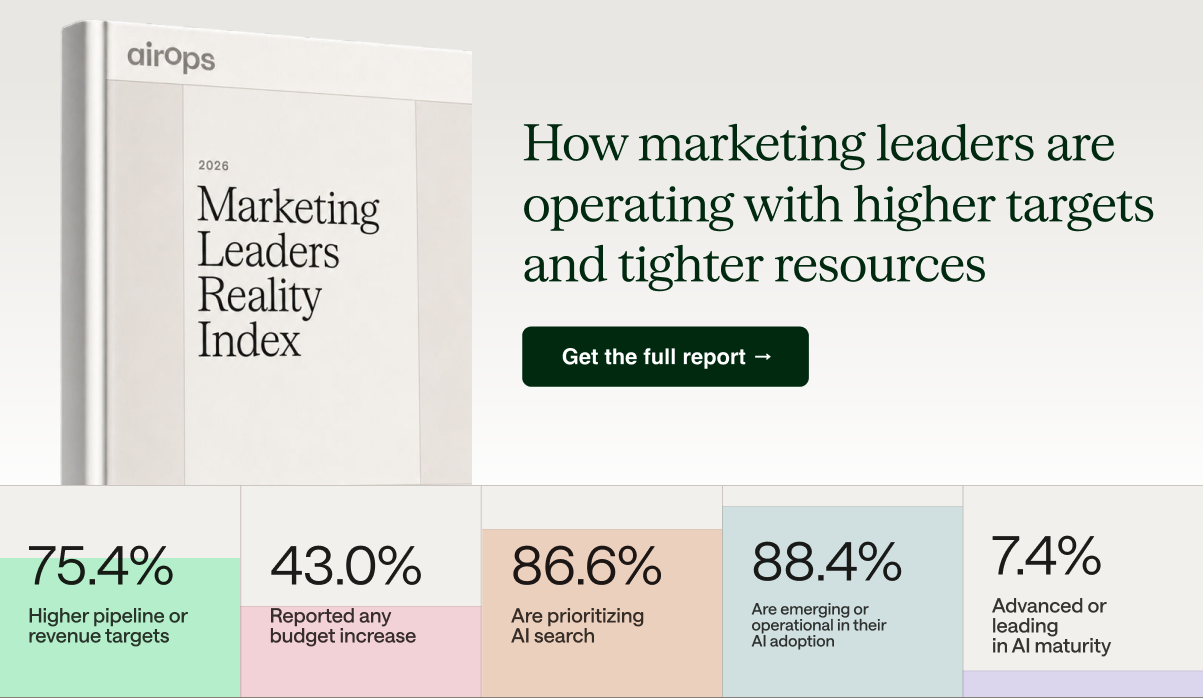
Marketing teams are increasingly inheriting revenue goals their budgets were never designed to support. When the plan breaks, marketing still carries the full commercial cost of the shortfall.
AirOps surveyed 300+ CMOs and VPs to measure exactly how widespread that pressure has become and reveal where leaders are reallocating resources as AI search rapidly changes the channel mix.
- Pressure-test your targets against the 75.4% of leaders carrying higher pipeline or revenue expectations.
- Strengthen funding conversations with proof that only 43.0% received additional budget.
- Identify your AI-search exposure, as 86.6% prioritize it while measurement confidence remains at 23%.
The Marketing Leaders Reality Index gives you a practical reference point for evaluating whether your operating model can support the results leadership expects.
See which moves other marketing leaders are making before they become standard practice.
Get the Marketing Leaders Reality Index.
🛒 Shoppers want AI to help them buy, but not sell to them
Four new developments show an interesting split in AI commerce: consumers are increasingly comfortable using AI to find and compare products, while authenticity, creator credibility and transparent advertising still matter.
The Breakdown:
AI Ads Need Labels - California’s SB 1050 requires disclosures when prominent AI-generated performers appear in video or audio ads, including product demonstrations and narration. The law was backed by SAG-AFTRA, while major advertising groups opposed the mandate.
AI Helps Buy, Not Create - Net Conversion research found shoppers are comfortable using AI as a buying assistant, but respond worse to advertising creative that appears machine-made, creating a divide between AI-powered shopping and AI-generated marketing.
Creator Sources Build Trust - 80% of surveyed consumers are comfortable using AI for product recommendations, while 56% prefer recommendations that include creator or influencer reviews. Credible creator reviews increased confidence in AI recommendations for 65%.
Budgets Follow AI Shopping - Ecommerce brands expect 63 cents of every new marketing dollar to go toward AI and cashback apps. Consumers already use AI to find lower prices (49%), promotions (46%) and compare alternatives (41%).
AI is gaining influence over what consumers discover and compare, but trust still comes from recognizable human signals.
👨💻 Quick Hits
📊 Billo analyzed 80,069 Meta video ads to reveal what strong Q4 performance actually looks like across 14 categories. Enter your results to see your category’s benchmark, peak month, and biggest performance gap in under a minute. Check your Q4 benchmarks before you scale another ad.
🧵 Meta is making Threads ads more independent, removing matching Instagram username requirements and letting businesses without Instagram accounts advertise directly from native Threads profiles starting September 2026.
🔍 X is expanding Under the Hood to show when posts or accounts have reduced visibility due to local laws, including which countries requested content restrictions or withholding.
🎬 42% of Snapchat users watch microdramas daily, with 64% familiar with at least one short-drama platform. Snapchat says viewers increasingly share episodes, discuss storylines and pay for creator content.
📊 Google Ads can now combine tag-based conversions with offline CRM data, filling missing customer details and correcting conversion values to improve Enhanced Conversions measurement and Smart Bidding accuracy.
That’s a wrap for today! Tell us your thoughts about today's content as we line up more Shorts! And don’t hesitate to share this with someone who’d adore it. 🥰