
Your creative has a fingerprint
🧐 Format fatigue isn't about the ad. it's about what your warm audience learned to recognize as yours, Google automates more PMax creative while Microsoft upgrades conversion tracking, and more!
Hey there Smarty 👋
Are you geared up to catch the latest and greatest in quick shorts?
And just a quick heads-up! If you stumbled upon us through a friend, make sure to subscribe here! That way, you’ll never miss out on the trending shorts.

🧐 Your creative has a fingerprint
A winning ad fatigues, and the standard fix is a new format in-house, a different visual style, a different pacing, produced by the same team that made everything else in the account. Sometimes that resets performance.
Sometimes it doesn't, and the reason it doesn't isn't that the new format was weak. It's that the audience wasn't reacting to the old ad specifically. It was reacting to a pattern trained across the account's entire creative history, and one new format doesn't erase a signature built from dozens of ads before it.
Diagnose which kind of fatigue is actually happening before building a new format. When a fresh, genuinely new-to-the-account format underperforms, split the result by audience type before concluding the format failed.
If it performs fine among cold prospecting traffic but still underperforms specifically among warm retargeting audiences, that's not format fatigue on the new ad.
It's evidence the warm segment has pattern-matched the account's broader creative style, camera angle habits, pacing, editing choices, regardless of what the format nominally changed, and no further in-house iteration is likely to break that specific signal.
Source the reset from outside the account's own creative history once that's confirmed. A warm audience trained on an account's creative handwriting hasn't been trained on a competitor's or an adjacent niche's, which is why structure pulled from outside the account resets recognition more reliably than another internal attempt, even a genuinely different one.
The value isn't novelty for its own sake. It's that the specific audience segment showing fatigue has no prior exposure to that particular structural pattern, unlike every in-house format, which shares some DNA with everything else the team has produced.
Strip the account's own stylistic tells when adapting a swiped structure, or the reset doesn't actually happen. Pulling a competitor's or adjacent niche's format and rebuilding it in the account's usual editing style, familiar pacing, familiar framing conventions, familiar voiceover cadence, can still get pattern-matched by a warm audience that's learned to recognize those specific execution habits, even inside a nominally new structure.
Rebuilding the swiped structure with genuinely different execution choices, not just a different underlying idea, is what actually resets recognition rather than producing a new format that still reads as unmistakably the same account.
The audience isn't tired of one ad. It's learned to recognize a signature across many, and the fix for that lives outside the account's own back catalog, not inside another round of the same team trying again.
Together with AirOps
Your AI Visibility Can Disappear Before Tomorrow
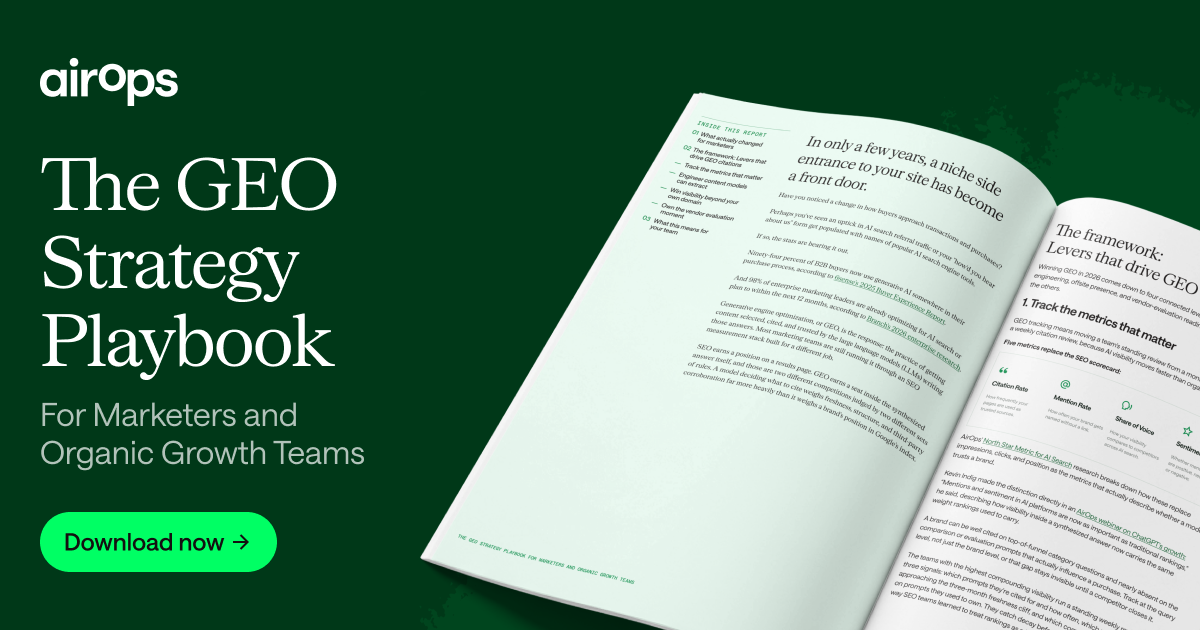
Your brand can appear in an AI answer this morning and disappear by afternoon. That volatility quietly redirects high-intent buyers toward competitors while your SEO reports show nothing unusual.
AirOps built The GEO Strategy Playbook to map the system behind brands that stay visible across repeated AI searches.
You’ll learn how to:
- Find the purchase-intent prompts where competitors are replacing you before those losses reach the pipeline.
- Identify the external pages shaping AI recommendations, so you know exactly where stronger brand coverage can influence the shortlist.
- Turn proprietary data and expert insight into quotable proof that models can confidently use.
Only one in five brands remained visible across five identical AI searches. If you are checking quarterly, you may be measuring visibility your brand has already lost.
You’ll walk away knowing what drives AI citations and how to track where your brand gains or loses visibility each week.
📊 Google and Microsoft Reshape Ads
Google and Microsoft are adjusting everything from measurement to creative automation and mobile ad formats. For advertisers, these changes affect how campaigns are measured, built, and ultimately displayed.

The Breakdown:
1. Mobile Ads Get Bigger - Microsoft is testing full-block images in mobile Bing ads, while Google experiments with larger review stars in sponsored results. Both give visual assets and ratings significantly more screen real estate.
2. PMax Videos Get AI - Google will use generative AI to fill missing video aspect ratios, opening existing PMax creative to more inventory. Advertisers wanting manual control must opt out by September 4.
3. Microsoft Goes Server-Side - Microsoft's beta Conversions API sends conversion data directly from advertiser systems. It works alongside UET rather than replacing it, expanding measurement across offline and cross-channel customer activity.
4. Brand Measurement Changes - Google's Branded Searches now supports YouTube and Demand Gen, but no longer lists PMax. Its default conversion window is seven days, and the metric cannot be used for bidding.
Google and Microsoft are steadily giving automation more influence over creative and measurement while making ads more visually prominent. Advertisers gain reach, but keeping control of tracking, assets, and feeds becomes increasingly important.
👨💻 Quick Hits
⚠️ Copying prompts without seeing the reasoning behind them creates false confidence. This Omnisend session reveals both the prompts and the judgment Jimmy Kim, Chase Dimond, and Bernard Meyer use when real campaign performance is at stake. Watch the session for free.
🤖 Meta AI becomes a business assistant for SMBs. Meta AI can now connect Facebook, Instagram, Ads, and Google Workspace data to analyze performance, recommend improvements, generate documents, and create recurring business tasks.
💻 Meta AI launches on Mac. Meta’s new desktop app can see shared windows, offer contextual advice, use system-wide dictation, analyze business and ad performance, benchmark competitors, and create decks, documents, spreadsheets, and recurring tasks.
📊 Google Ads API Adds Deeper Measurement and Benchmarking. Version 25.1 introduces lift-study metrics, category-specific competitive benchmarks, brand sentiment and loyalty insights, plus original conversion values before Google applies optimization adjustments.
📉 Clicks and LinkedIn Reach Are Collapsing, But AI May Not Be the Real Problem. Organic clicks are reportedly down 42% and LinkedIn reach 47%, pointing to structural distribution changes that reward rebuilding around audience value instead of rented platforms.
That’s a wrap for today! Tell us your thoughts about today's content as we line up more Shorts! And don’t hesitate to share this with someone who’d adore it. 🥰