
Your best ad is hidden in your data
📊 The exact four-step process for turning one real data point into the line that stops the scroll, Creator Studio gets personalized AI while WhatsApp adds on-device scam alerts, and more!

Hey there Smarty 👋
Are you geared up to catch the latest and greatest in quick shorts?
And just a quick heads-up! If you stumbled upon us through a friend, make sure to subscribe here! That way, you’ll never miss out on the trending shorts.

📊 Your best ad is hidden in your data
Specific numbers stop people because they feel discovered, not invented.
“62%.” “11 days.” “34% less effort.”
The problem is that many brands work backwards. They start by looking for a number that sounds persuasive instead of finding one that’s already true. Besides creating trust issues, that approach is increasingly risky as platforms and regulators pay closer attention to numerical claims in advertising.
A much better process is to build the creative around data you already have.
Step 1: Mine the numbers you’re already collecting
Most brands are sitting on useful data without realizing it.
Look through post-purchase surveys, customer support conversations, return reasons, product onboarding, before-and-after tracking, or review responses.
The goal isn’t new research. It’s uncovering a number customers have already given you.
Step 2: Keep the number exactly as it exists
The strongest numbers usually aren’t round.

People naturally associate oddly specific numbers with something that was actually counted.
Changing them into cleaner marketing language often removes the credibility that made them interesting in the first place.
Step 3: Capture the reaction, not the statistic
Don’t brief creators to recite the finding. Brief them on the discovery itself.
When someone reacts naturally to learning that 62% of customers experienced something, viewers aren’t just hearing a statistic. They’re watching someone process unexpected information in real time, which feels considerably more believable than reading a polished script.
Step 4: Verify the claim before it goes live
Every number should be traceable to an internal source. If someone asked where it came from tomorrow, the supporting data should already exist. That final check protects more than compliance. It protects credibility.
For teams building large volumes of UGC, Insense makes this workflow much easier by giving brands access to creators who can produce 20+ raw clips with lifetime usage rights from a single brief,
making it practical to test multiple genuine reactions around the same verified insight instead of relying on one scripted version. You can book a free strategy call by August 28 and receive $200 toward your first campaign.
The statistic isn’t what earns attention. The trust comes from knowing the number is real, and letting people react to it like they’re seeing it for the first time.
Together with Omnisend
Everyone’s talking about AI. Here’s how three email marketing experts are actually using it.
What do experienced email marketers actually ask AI when real campaign decisions are on the line?
In this free 56-minute session, Jimmy Kim, founder of eCom Email Marketer, and Chase Dimond, co-founder of eCom Email Marketer, open up their workflows and show the prompts they use to review performance, pull useful reports, and decide what to do next.
You’ll learn:
- How to spot missed opportunities hiding in your campaign data
- The exact prompts Jimmy and Chase use to pull reports, analyze campaigns, and take action
- Where AI genuinely improves email marketing and where human judgment still needs to lead
The session was recorded in ChatGPT, but Omnisend works with Claude too, so the same workflows carry over.
New to Omnisend? It’s an email and SMS marketing platform used by more than 150,000 ecommerce brands, generating an average of $79 for every $1 spent.
Migration is free, takes up to five business days, and plans cost up to 35% less than Klaviyo’s.
Watch the full 56-minute session, no signup required.
📱 Meta's AI grows audiences and spots scams
Meta is using on-device and account-level AI for two very different problems: helping creators grow and helping users judge suspicious messages. Together, the updates show how AI is becoming an invisible layer between brands, creators, and their audiences.
The Breakdown:
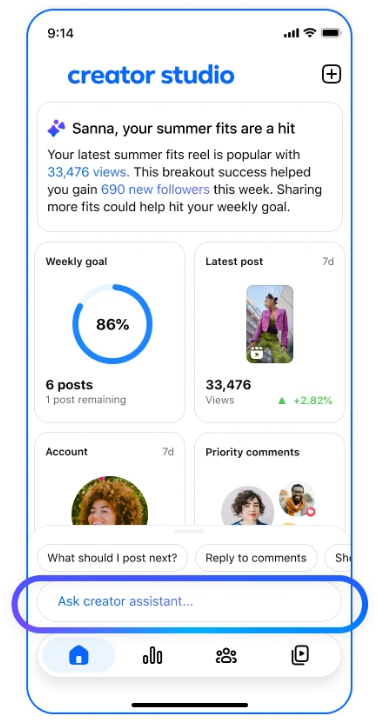
1. Personalized Creator AI - Creator Studio analyzes each creator’s actual account, audience, and content to recommend formats and growth opportunities. Early testers reported a 144% earnings increase in seven days, while another gained 4,000 followers from one recommended format.
2. Smarter Engagement - The app identifies comments worth answering and drafts replies in the creator’s voice. Creators retain final control, making community management faster without completely automating the relationship.
3. Private Scam Detection - WhatsApp’s Scam Alert checks messages from non-contacts using an optional model running entirely on the device. If something looks suspicious, users can block, report, continue, or trust the conversation.
4. Marketing Gets Harder - For WhatsApp marketers, message quality could increasingly resemble email deliverability. Cold promotions that use suspicious linguistic patterns could trigger warnings, making trusted sender identity, context, and natural copy more important.
Meta is simultaneously making AI a growth assistant for creators and a trust layer for consumers. For marketers, that creates an interesting split: AI may make reaching and engaging audiences easier, while also raising the standard for what gets trusted once it reaches them.
👨💻 Quick hits
🎥 X now lets iOS users add text and emoji overlays directly to uploaded videos, expanding its basic editing toolkit. It is a small upgrade, but another step toward X’s long-promised push to become a more video-focused platform.
🔎 Google lowered eligibility for Search profiles to 35,000 followers on YouTube, Instagram, or X, and 100,000 on TikTok. Eligible creators also gain search-term, ranking, and volume insights, while YouTube is expanding copyright alerts to channel managers.
🛒 Google clarified that Merchant Center for Agencies can link up to 1,000 client accounts under one agency account. The update adds no new functionality, but gives large agencies a concrete limit for planning client onboarding and account structures.
🛒 A study of 2,000 Americans found 94% consider free shipping when choosing where to shop, while 69% avoid retailers without free returns. AI is influencing shopping too, with 80% using tools like ChatGPT or Claude, although reviews remain far more trusted.
That’s a wrap for today! Tell us your thoughts about today's content as we line up more Shorts! And don’t hesitate to share this with someone who’d adore it. 🥰