
The Pages AI Refuses To Quote
🫠 Three-page mistakes quietly costing you AI visibility, TikTok grows commerce through managed services and stricter enforcement, and more!
Hey there Smarty 👋
Are you geared up to catch the latest and greatest in quick shorts?
And just a quick heads-up! If you stumbled upon us through a friend, make sure to subscribe here! That way, you’ll never miss out on the trending shorts.

🫠The Pages AI Refuses To Quote
Traffic from AI search keeps growing, and most teams still haven't figured out how to turn it into a pipeline. Comparison pages, pricing pages, and feature pages either aren't getting cited by AI models at all or they get cited and still don't convert once someone actually clicks through. Three specific mechanisms explain why, and each one is fixable before the next content cycle starts.
Comparison pages fail extraction because they try to answer fifteen questions at once. A model pulling a comparison answer needs one clean, isolated claim, "X handles Y better because Z," not a sprawling matrix covering every feature side by side.
The standard battle-card format that sells well to a human skimming a table is structurally the wrong shape for a model trying to extract a single defensible answer.
Split the page into individually isolated comparison claims, each one a complete, standalone answer to one specific question, and extraction rates improve because there's no ambiguity about which row the model is even citing.
Pricing and feature pages lose extraction to their own hedging language. "Starting at," footnoted caveats, and conditional pricing tiers are honest, and they're also exactly the kind of ambiguity a model avoids citing outright, since an incorrect extracted price creates real risk for whoever's answer engine got it wrong.
A plain, declarative sentence stating the fact once, unhedged, paired with structured data markup behind it, gets cited far more reliably than the same fact buried in three qualifying clauses.
Third-party corroboration needs to clear a real threshold, not just exist. A single G2 review or one Reddit mention rarely moves the needle alone.
Models weigh a claim more heavily once it appears independently across at least two separate external domains, G2 and a Reddit thread, or Capterra and a review blog, because that's the pattern that reads as corroboration rather than coincidence. One mention is a data point. Two independent ones are a signal.
On August 5 at 2 pm ET, Josh Grant, founder of StackedGTM and former VP of Growth at Webflow, joins AirOps' Josh Spilker to go deeper on all three live-auditing feature pages against Josh's full framework and send every attendee home with a ranked fix-it list specific to their own pages.
You can secure your free spot. Can't make it live? Register anyway, and the recording lands in your inbox within 24 hours.
Together with Tatari
Your BFCM CAC problem starts before November.
By November, every brand is fighting for the same shoppers in the same channels: Meta, search, email, affiliates, and discounts. That’s when CAC gets expensive.
The brands that outperform during BFCM don’t just wait to capture demand. They create it earlier, often with channels their competitors haven’t fully tapped yet, like TV.
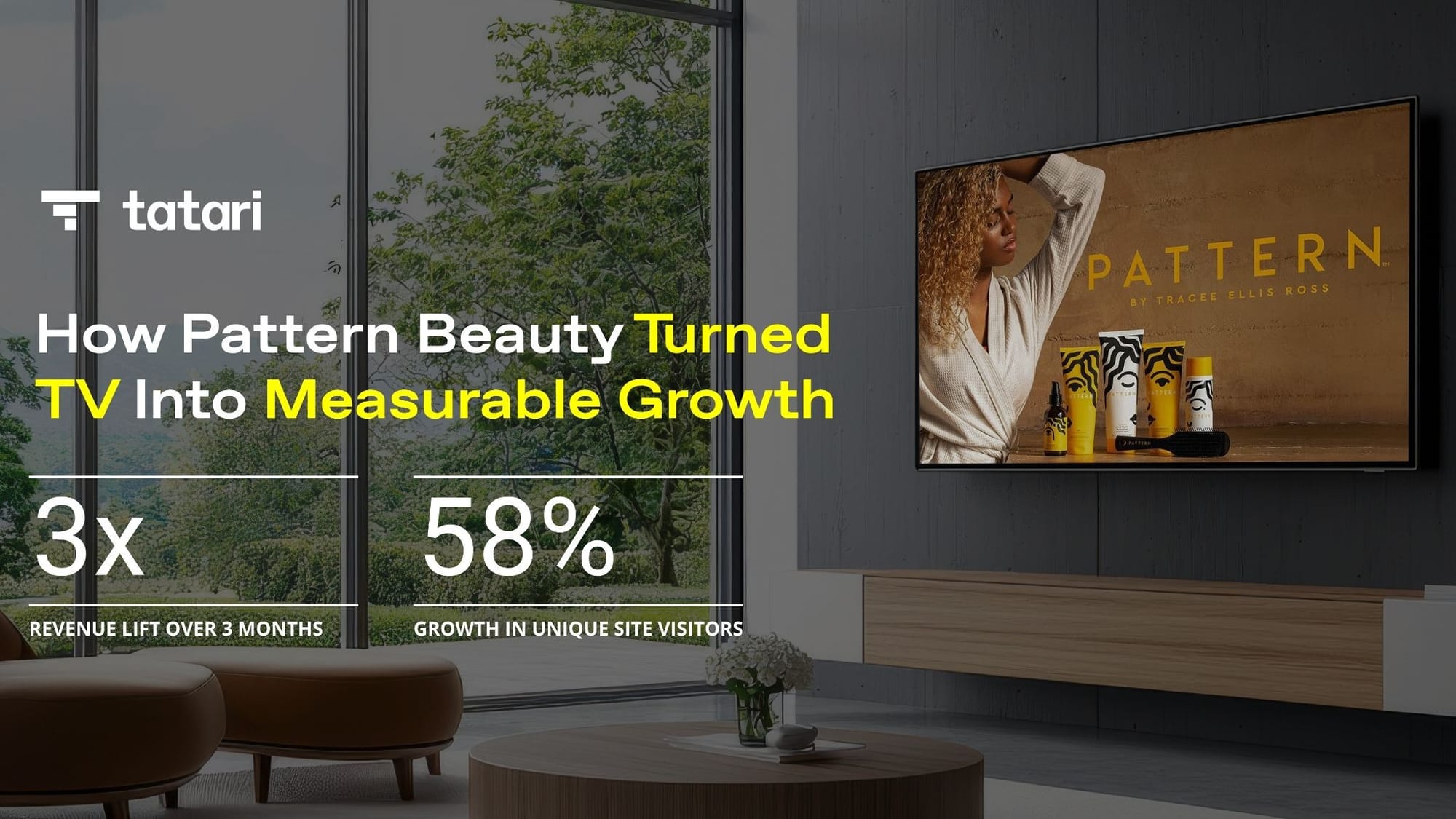
PATTERN Beauty shows what that can look like. With Tatari, the brand ran a phased 12-week campaign across streaming and linear to build awareness, drive site traffic, and measure revenue impact from day one. No massive TV budget required.
The results:
- 58% growth in unique site visitors
- 3x revenue lift from month one to month three on similar budgets
- 50% higher brand consideration than social and digital alone
TV didn’t replace PATTERN Beauty’s digital stack. It gave digital more demand to capture before shoppers were already in-market.
Over 400 brands like Jones Road Beauty, Fabletics, and Calm built TV into their core growth stack with Tatari. It shows you exactly where every dollar ran and what it produced.
Book a free demo and build demand with TV before Q4 gets crowded.
🛍️ TikTok Expands Commerce Push
TikTok is tightening its control over e-commerce while reshaping how brands sell on the platform, introducing managed services, stricter livestream rules, and strengthening its position in the global advertising market.
The Breakdown:
Managed Services Launch - TikTok is piloting a service that manages sellers' ads, creators, product listings, GMV Max campaigns, and hundreds of AI-generated videos for a $10,000 flat fee plus 10–20% commission.
AI Voice Ban - TikTok Shop now prohibits AI-generated voices, pre-recorded audio, and radio-style narration in shopping livestreams, requiring sellers to use live human hosts instead.
Account Health Rules - Violations now impact TikTok's new Account Health Rating (AHR), where repeated offenses can limit campaign access, suspend seller programs, and ultimately deactivate accounts.
Ad Revenue Growth - WARC projects TikTok will overtake YouTube in global advertising revenue by 2030, as marketers continue shifting budgets toward social commerce and lower-funnel performance campaigns.
TikTok is taking greater control of its commerce ecosystem by managing seller operations, enforcing stricter livestream standards, and expanding its advertising business, signaling a broader push to become a full-service commerce platform.
👨💻 Quick Hits
📦 InoPro scaled Amazon sales 7x and generated 1.3M impressions from 668 promotions through Stack Influence by paying creators only in product, so every unit mapped to a real purchase and content they kept forever. Book a free demo today and save 10% on your first campaign.
🤖 Meta has launched Muse Spark 1.1, a new multimodal AI model focused on reasoning, coding, and agentic automation, while introducing paid developer access as it looks to turn its AI investments into a sustainable business.
📈 Google has added business data feeds to Demand Gen campaigns, letting travel, real estate, and automotive advertisers create dynamic ads from structured business data without needing Google Merchant Center.
🔄 X has updated its algorithm to show users more posts from people they mutually follow, boosting friends' visibility in replies and feeds to encourage more relevant conversations and interest-based communities.
🔎 Google AI Mode now shows text ads on nearly 30% of commercial searches, with high-CPC keywords driving most placements, while paid ads showed little impact on AI citations or organic search rankings.
That’s a wrap for today! Tell us your thoughts about today's content as we line up more Shorts! And don’t hesitate to share this with someone who’d adore it. 🥰