
Skimmable isn't extractable
📖 Writing that reads well to a human often fails the exact test an AI agent runs before quoting your content. Meta, TikTok, and ChatGPT roll out new ad tools, and more!

Hey there Smarty 👋
Are you geared up to catch the latest and greatest in quick shorts?
And just a quick heads-up! If you stumbled upon us through a friend, make sure to subscribe here! That way, you’ll never miss out on the trending shorts.

📖 Skimmable and extractable are not the same skill
Ecommerce teams optimizing product pages for AI agents converged on a specific finding this year: agents evaluate pages programmatically, checking attribute completeness and whether claims contradict spec data, and a page failing either check gets skipped rather than penalized.
That standard has quietly become the model for a much bigger category of content than product pages.
Most content teams write for skimming: short paragraphs and bolded phrases that let a human's eye land on what matters.
That skill produces content a human reads quickly. It does not reliably produce content a model can extract cleanly, because skimmable and extractable optimize for different things.
Test extraction against your own best-performing page
Take your highest-traffic article or guide and ask a model to answer three specific questions using only that page as source material, not the topic in general.
Where the model has to infer, combine two separate sentences, or guess at a qualifier the page never states outright, that's a section a human skims past successfully, but an extraction pass fails on.
Skimmability and extractability diverge exactly there, and it's usually invisible until you run the test.
Write the fact, then the frame, in that order
Human-oriented writing often leads with the frame, a story or analogy, arriving at the specific fact after the setup earns it.
That structure reads well. It also buries the extractable fact inside narrative context a model has to parse through first.
Flip the order for any sentence carrying a number, a specific claim, or a named comparison. State the fact plainly first, then add the framing or narrative color after it, in the same paragraph if the piece's voice depends on it.
The fact survives extraction either way once it isn't the thing doing the work of holding the reader's interest.
Separate the two audiences instead of compromising between them
Trying to write one sentence that's both a compelling human hook and a clean extractable fact usually produces a sentence that's mediocre at both jobs.
Structure pieces with the narrative hook doing the human-engagement work up top, and a distinct fact-and-source section, plainly stated, carrying the extractable content.
Readers get the version built for them, agents get the version built for them, and building both at scale without slowing a content calendar is the production problem AirOps solves for teams running this at volume, the kind of capability gap its Marketing Leaders Reality Index found only 43.0% of teams got funding to close.
Neither audience is optional anymore. Writing for only one of them is a choice, just not one most teams are making on purpose.
Together with Insense
1 UGC creator = 20+ ad variations to scale your Q4 creatives
Insense makes UGC ads insanely cost-effective - and Andromeda-approved!
Meta's Andromeda update now rewards creative diversity (+22% ROAS), so the more distinct hooks and angles you test, the better you rank.
From one brief, get numerous raw footage clips to mix, match, and turn into multiple scroll-stopping creatives for your paid social ads.
Source 20+ pieces of raw content (per creator) with lifetime usage rights, all delivered in 14 days or less.
Here's the Q4 math: one winning ad takes 10–13 tested creatives, so 20+ variations per creator means more shots at a winner, and instant hook-swaps when an ad fatigues during BFCM week. Many versions from one shoot, not 50 shoots.
That’s how over 3,500 brands like Beauty Pie, Il Makiage, Revolut, and Monster Energy scale UGC without killing team bandwidth.
Cost-effective UGC with lifetime usage rights? Yes please!!
Book a free strategy call by August 28 and get $200 for your first campaign.
📣 Meta, TikTok and ChatGPT roll out new ad tools
Three major platforms are expanding their ad products in very different directions. Meta is turning Instagram comments into DM leads, TikTok is taking creator content onto physical screens, and ChatGPT Ads is adding more of the controls advertisers expect from mature ad platforms.
The Breakdown:
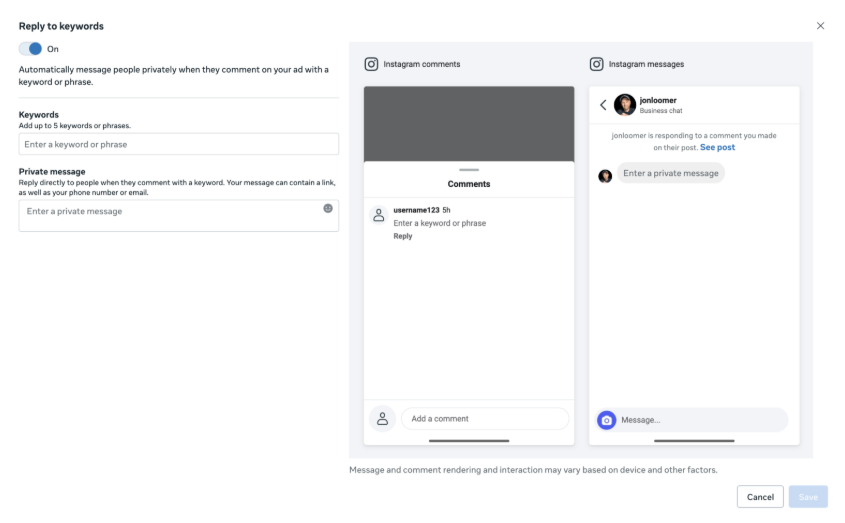
Meta can turn comments into DMs - A new Instagram ads test lets advertisers choose up to five keywords and automatically send a private message when someone comments with one, making “comment X for more” campaigns much easier to run.
TikTok ads are moving beyond TikTok - Its Out of Phone program is expanding across Europe, letting brands place TikTok and creator content on screens in malls, supermarkets, universities, bars and other physical locations.
ChatGPT Ads gets automated bidding - The new Maximize results strategy automatically adjusts bids toward an advertiser’s chosen campaign goal, bringing more algorithmic optimization into the platform.
ChatGPT adds better targeting and attribution - Advertisers can separately target iOS, Android, and web, while new one-day view-through reporting measures conversions that happen after an ad impression without a qualifying click.
These updates show three different ways ad platforms are trying to capture more of the customer journey. Meta wants to own the conversation, TikTok wants its content to travel beyond the app, and ChatGPT is quickly building the optimization and measurement infrastructure advertisers already rely on elsewhere.
👨💻 Quick hits
⚠️ Copying prompts without seeing the reasoning behind them creates false confidence. This Omnisend session reveals both the prompts and the judgment Jimmy Kim, Chase Dimond, and Bernard Meyer use when real campaign performance is at stake. Watch the session for free.
🎬 Instagram launches first draft for Reels. The new tool automatically picks the best moments from selected clips, removes pauses, and trims them into a ready-to-edit Reel in seconds.
📺 YouTube lets users build multiple custom feeds. Users can create up to eight personalized video feeds using conversational prompts, then edit each prompt to fine-tune what YouTube recommends.
🌐 .Org Sites Are 34% More Likely to Generate Ecommerce Revenue Than .com. Wix data also found .store sites earn 10% more than .com, while registrations for .ai and .io domains are surging.
🎯 Google tests new Performance Max channel controls. Advertisers may soon be able to tell PMax to prioritize or pull back from Search, YouTube, Display, Discover, Gmail, and Maps by adjusting the CPA economics for each channel.
That’s a wrap for today! Tell us your thoughts about today's content as we line up more Shorts! And don’t hesitate to share this with someone who’d adore it. 🥰