
Google may replace your search pitch
🧐They are testing AI summaries inside the snippet itself. Your meta description might already be obsolete, Meta and Google push AI deeper into ad management, and more!

Hey there Smarty 👋
Are you geared up to catch the latest and greatest in quick shorts?
And just a quick heads-up! If you stumbled upon us through a friend, make sure to subscribe here! That way, you’ll never miss out on the trending shorts.

🧐Google is testing AI summaries inside the snippet itself. your meta description might already be obsolete.
Search Engine Roundtable reported Google testing AI-generated summaries directly inside individual search snippets, rather than limiting generated answers to the separate AI Overview. If that expands, a carefully written meta description may no longer be the copy a searcher sees before deciding whether to click. Google could increasingly build that pitch from the page itself.
Find where you’ve already lost control
Start with the ten pages responsible for the most organic traffic. Search their primary terms and put the live Google snippet beside the meta description currently on file.
You’re looking for one thing: divergence.
For every mismatch, record what Google used instead. Did it pull the opening paragraph? A sentence beneath a subheading? Pricing copy? A product detail buried further down?
Don’t immediately rewrite anything. Ten pages are enough to reveal whether Google is already consistently preferring a certain type of passage over the descriptions your team wrote specifically for search. That pattern tells you what part of the page may increasingly function as the real meta description.
Write the opening so it can survive being stolen
Take the worst divergence from the audit and rebuild its opening using a simple constraint:
If Google could extract only one sentence from this page, would sentence one make a good search pitch?
A SaaS pricing page shouldn’t spend its opening explaining the company’s mission and reveal the price three paragraphs later. If the useful answer is “$49 per month for five users, including X and Y,” put that information where it can stand alone.
Then add context underneath it.
This isn’t about stuffing keywords into the introduction. It’s about making the page’s most important information understandable without requiring the sentences around it, because generated summaries need passages that can survive extraction.
Don’t trust the rewrite until the snippet changes
Keep the existing meta description untouched on a test group of pages. Rewrite only their openings, record the date, then monitor what appears for the same queries.
Now there are three outcomes worth separating.
If the generated snippet changes and CTR improves, the new opening likely gave Google stronger material. If the snippet changes but CTR falls, you’ve gained more control over what gets extracted but written a worse pitch. If the opening changes and the snippet doesn’t, body copy probably wasn’t the lever for that query in the first place.
That makes the experiment considerably more useful than simply comparing CTR before and after a rewrite.
Semrush’s AI Visibility Toolkit helps monitor how a brand and its pages appear across Google’s AI surfaces alongside other AI platforms, making shifts in search visibility easier to catch as generated experiences evolve. You can try free for 7 days.
The meta description may be losing its monopoly over the search pitch. The response isn’t abandoning it. It’s making sure the page itself can make the sale when Google decides to write the preview instead.
Together with Omnisend
Your AI Is Missing Your Best Marketing Data

Your email platform holds the data behind better campaign decisions. By the time you’ve translated the numbers for your team, the next campaign is already underway.
Omnisend’s guide shows 10 ways to connect ChatGPT and Claude to your account data and reach decisions faster.
- Compare this week’s performance with last week’s and get changes explained in plain English.
- Analyze six months of subject lines to uncover the wording patterns your audience consistently opens.
- Generate a monthly executive summary with priorities, without losing another afternoon to reporting.
The guide comes from a platform used by 150,000+ ecommerce brands, whose customers average $79 in revenue for every $1 spent across Omnisend channels.
Users can get a free migration completed in five business days, with pricing up to 35% lower than Klaviyo at comparable tiers.
See what becomes possible when AI can work with your real email data, then decide whether your current platform is keeping up.
📊 Meta and Google push AI deeper into ad management
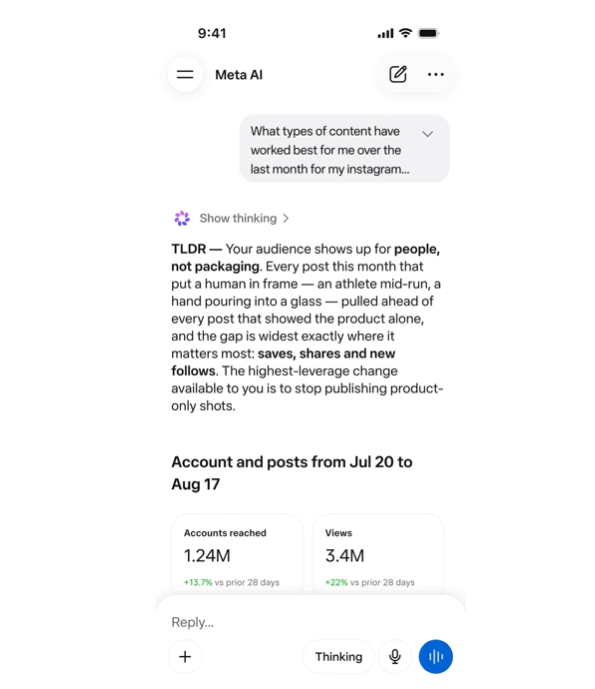
Meta and Google are moving AI beyond ad creation and into the decisions marketers make after campaigns launch. New tools can analyze performance, recommend changes, test strategies, and automate reporting.
The Breakdown:
1. Meta AI Becomes an Ads Analyst - Advertisers can connect Meta Ads directly to Meta AI and ask about performance. It can identify strong audiences, creative patterns, fatigued ads, and opportunities to improve budget allocation.
2. Reporting Gets Automated - Meta AI can combine campaign data with Gmail, Docs, Sheets, and Slides, then generate reports, presentations, and spreadsheets. Recurring tasks can also automate regular performance reviews.
3. AI Max Gets Better Testing - Starting in September, Google will let advertisers A/B test budgets and ROI targets across multiple Search campaigns. Tests can retain brand and location controls instead of removing those guardrails.
4. Google Lets You Forecast Changes - Performance Planner can model how budget or bidding changes could affect existing campaigns before they're made. Advertisers can then apply Google's suggested changes directly with one click.
Meta and Google are turning their AI systems into campaign-management layers, moving from generating ads toward analyzing performance, testing decisions, forecasting outcomes, and recommending what marketers should change next.
👨💻 Quick hits
🚨 How many testing windows have you missed while waiting for creators to respond? Insense sends vetted creator applications within 48 hours, turning briefs into production before your current workflow finishes sourcing. Book a free strategy call by August 28 and get $200 platform credits towards your first campaign.
🗑️ 1M people have already reported AI slop on LinkedIn. LinkedIn’s new “AI slop” reporting option crossed one million uses in two weeks, while content the platform identifies as low-substance AI slop is now receiving 40% fewer views.
🎮 Meta brings its vibe-coding app Pocket to the US. Pocket lets anyone describe simple apps or games and have AI build them as interactive “gizmos,” which can then be shared, played, liked, and remixed by other users.
🔎 75% of LinkedIn’s AI citations come from people, not brands. Research analyzing 9.5 million AI citations found individual profiles dominate LinkedIn citations, while structured, data-backed how-to and comparison content is especially likely to get cited.
📉 Microsoft is removing max CPC controls. Starting Oct. 1, new standalone Maximize Conversions, Maximize Conversion Value, and Maximize Clicks campaigns can’t set CPC caps, pushing advertisers toward tCPA, tROAS, and other automated controls.
That’s a wrap for today! Tell us your thoughts about today's content as we line up more Shorts! And don’t hesitate to share this with someone who’d adore it. 🥰