
Deeper discount or pay later?
⚖️ Which lever should lead your Black Friday ads, Google’s new YouTube Target Frequency options, and more!
Hey there Smarty 👋
Are you geared up to catch the latest and greatest in quick shorts?
And just a quick heads-up! If you stumbled upon us through a friend, make sure to subscribe here! That way, you’ll never miss out on the trending shorts.

⚖️ A deeper discount vs pay-in-four: which should lead your black friday offer?
Every Black Friday plan has a line labeled "offer," and it usually gets filled with a bigger percentage than last year.
There's a second lever that costs far less. Adobe tracked $1.03 billion in buy now, pay later spending on Cyber Monday 2025, when 79.4% of BNPL transactions happened on mobile devices. Across the full holiday season, BNPL spending reached $20 billion, up 9.8% from 2024. Shoppers are already splitting payments. The question is which lever your ads should lead with. Numbers below are illustrative.
Round 1: Cost per order
Take a $160 order. Adding 10 points of discount costs $16 on every order, from every buyer. A pay-later provider's merchant fee is usually a few percent of the order, so check your own rate; at 5% that's $8, and only on orders that use it.
Winner: pay-in-four.
Round 2: Pull on undecided shoppers
A bigger discount reduces the total price. "4 payments of $40" spreads the same $160 cost over time. Either could persuade an undecided shopper, so test which message produces more purchases at a margin you can afford.
Winner: let your conversion and margin results decide.
Round 3: Price point
On a $30 item, splitting the cost changes almost nothing. On a $300 item, four payments of $75 can turn a maybe into a yes. My judgment: below about $100, installments barely register; above $150, they start doing real work.
Winner: depends on price. Discount below $100, pay-in-four above $150.
Round 4: Category expectations
Adobe's Cyber Monday discount peaks ran 31% in electronics, 28% in toys and 25% in apparel. If your category trains shoppers to expect those numbers, installments alone won't compete with the shelf next door.
Winner: discount, in heavily discounted categories.
Round 5: What happens in January
Deep discounts teach your list to wait for the next sale. Installments leave your price intact, so your full-price ads in January aren't fighting the memory of 40% off.
Winner: pay-in-four.
The verdict
Use price as a starting point for testing, not a fixed cutoff. On lower-priced products, test a discount-led message; on higher-priced products, test installments alongside a discount that protects margin.
A $160 item with 15% off costs $136, or four payments of $34 if your provider offers that plan. Test "15% off, now $136" against "4 payments of $34, $136 total," with payment terms clearly visible. Let purchases and profit decide which message leads.
Before Friday, check that your installment option shows on product pages and in checkout on mobile, where most of that spending happens.
Together with New Engen
Your next winning ad needs a different voice
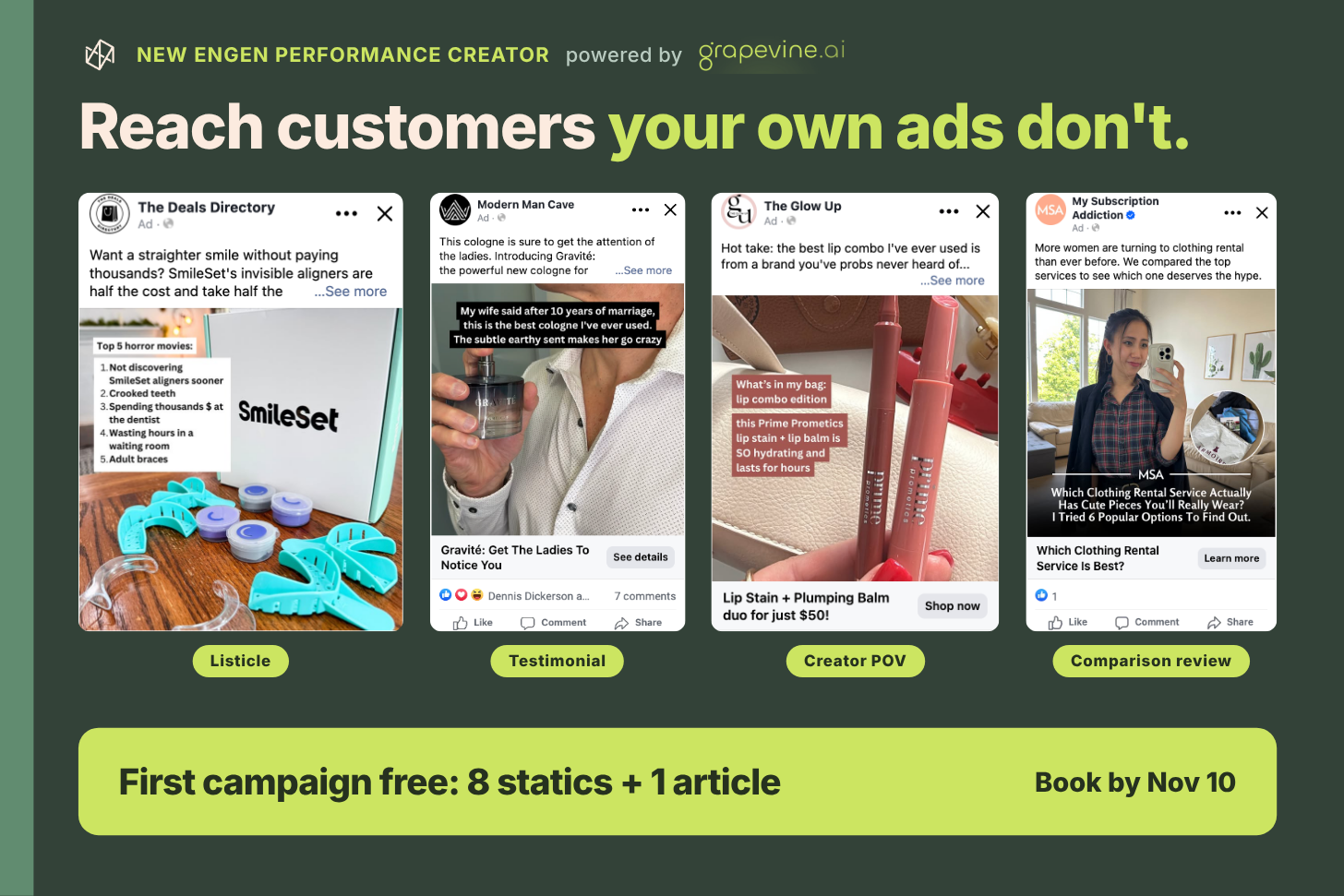
Your product solves a real problem. But when every ad makes a promise, buyers need a reason to believe yours.
A qualified expert explaining how it works can give them that reason.
Grapevine, now part of New Engen, creates ads delivered through creator and publisher handles with production managed from brief to launch.
You approve the angles and ship product. Grapevine sources creators, handles briefs and payments, then produces and posts the content.
- Madison Reed achieved 20% efficiencies over target CPA and 50% higher LTV.
- Mathnasium cut Meta CPL by 33% in under 30 days.
- Cirkul achieved 15-50% lower TikTok CPA and nearly doubled CTR through creator whitelisting.
Put this approach to work with your first campaign on Grapevine.
Kick off by November 30 and your first campaign is free: 8 statics and 1 article worth $1,500.
📢 Google, Instagram, and Microsoft introduce new advertising and shopping features
Google, Instagram, and Microsoft are rolling out updates to give advertisers more flexibility with video campaigns, help creators earn through affiliate links, and improve AI-powered ad reporting.
The Breakdown:
- Google now allows advertisers to combine non-skippable YouTube ads with Shorts and in-feed ads in Target Frequency campaigns, with non-skippable videos supporting up to 20 seconds.
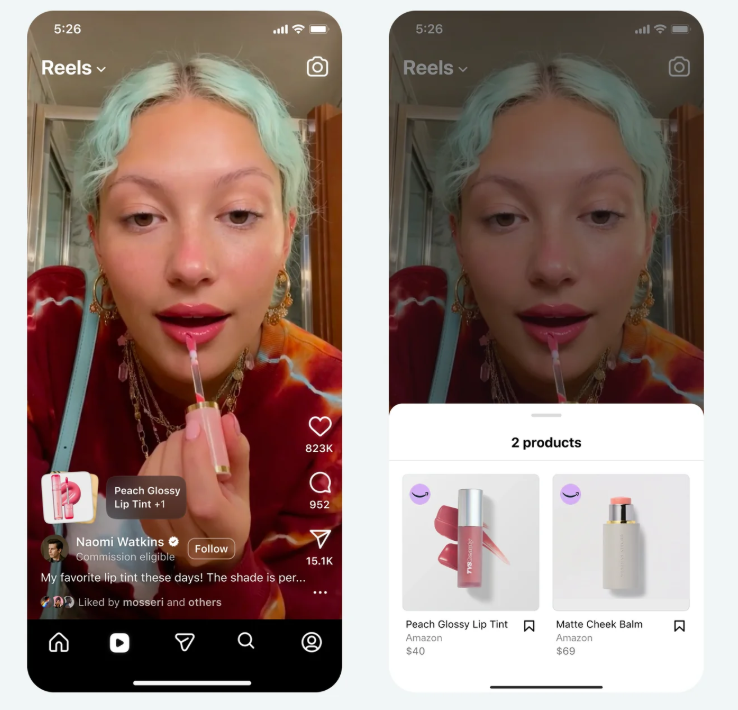
- Instagram has partnered with Amazon to let eligible creators add affiliate links directly to Reels and feed posts, earning commissions when viewers purchase products through their links.
- Creators can link up to 30 Amazon products per Reel and 20 per feed post. They can also view commission rates and connect their Amazon Influencer accounts through Instagram.
- Microsoft Advertising is introducing a Search term landing page report for AI Max, showing which search queries lead to specific landing pages, alongside improved filtering and negative keyword management.
These updates give advertisers more ways to reach audiences and understand campaign performance. Google is expanding video ad flexibility, Instagram is simplifying affiliate shopping, and Microsoft is making AI-powered search traffic easier to analyze.
👨💻 Quick Hits
🎬 YouTube expanded its Ask Studio AI assistant to Android and iOS, adding visual prompts, creator analytics insights, and AI-powered podcast clipping that converts longer episodes into captioned vertical Shorts.
🔎 LinkedIn says accounts with over 10,000 followers and company pages account for 65% of LinkedIn citations in AI chatbot responses, recommending that brands leverage credible employees, executives, and influential creators.
🎯 Google Ads updated its Personalized Advertising Policy to prohibit interest-based targeting across four content categories: counterfeit goods, dangerous products, dishonest services, and inappropriate content, clarifying existing advertising restrictions.
🔗 Google Ads clarified AI Max URL exclusions, introducing exact URL, custom label, and token-based matching rules, while warning that underscores, multiple conditions, and legacy DSA settings can affect exclusions.
💃Events
🔥 The Three Measurement Gaps to Fix Before Your Next AI Search Budget Review
November 20 | 2 PM ET | Virtual Event
Before leadership questions your AI search spend, know what your reporting can actually prove. Join AirOps COO Matt Hammel and Google Meridian creator Hitesh Wadhwani to examine attribution blind spots, evaluate brand exposure, and identify which measurements your team needs before reallocating budget.
Can't attend the session live? Register anyway, and you’ll get the recordings in 24 hours.
That’s a wrap for today! Tell us your thoughts about today's content as we line up more Shorts! And don’t hesitate to share this with someone who’d adore it. 🥰