
Evidence is the key to rankings
🤓Amazon’s AI doesn’t rank your product. It ranks your evidence, Third-party AI is replacing brand chatbots, according to Gartner, and more!

Hey there Smarty 👋
Are you geared up to catch the latest and greatest in quick shorts?
And just a quick heads-up! If you stumbled upon us through a friend, make sure to subscribe here! That way, you’ll never miss out on the trending shorts.

🤓 Amazon’s AI Doesn’t Rank Your Product. It Ranks Your Evidence.
For years, Amazon SEO was about making a product discoverable. AI shopping assistants change the game.
The new challenge isn’t getting found. It’s giving the assistant enough confidence to recommend your product when a shopper asks a specific question.
“Will this fit under my kitchen cabinet?”
“Does it survive the dishwasher?”
“Will this work for curly hair?”
Amazon states that its AI shopping assistant answers questions using information from product detail pages, customer reviews, customer Q&A, its product catalog, and other trusted sources. When information is incomplete or inconsistent, the quality of the answer suffers.
That means every listing now has something most sellers never measure:
Evidence coverage.
Here’s how to audit it.
1. Build an Answer Coverage Matrix. List the 15 highest-commercial-intent questions a customer asks before buying your category. Don’t guess. Pull them from Customer Q&A, negative reviews, support tickets, return reasons, competitor reviews, and Amazon’s suggested questions.
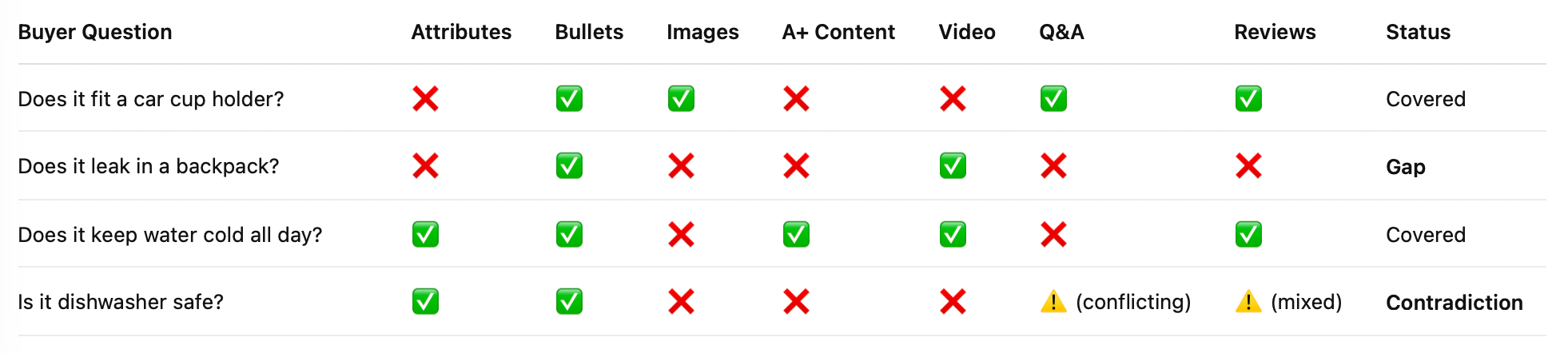
Now create a table with every question as a row and every evidence source as a column: attributes, title, bullets, images, A+ Content, video, Q&A, and reviews. Empty cells are answer gaps. If “Is this leakproof in a backpack?” isn’t answered anywhere, the assistant has nothing reliable to retrieve.
2. Eliminate Contradiction Debt. Open every source that answers the same question. If your bullets say “dishwasher safe,” a review says “top rack only,” and a customer answer says “hand wash recommended,” you’ve created competing evidence.
AI assistants don’t know which version to trust. Every contradiction reduces confidence before the customer even reaches your listing. Standardize factual claims first, then update older assets that no longer match the product.
3. Create an Evidence Priority Stack. Every source has a job. Structured attributes should carry measurable facts like dimensions and materials. Images should prove visible claims. Video should prove performance.
Reviews should prove lived experience. Q&A should resolve edge cases. Don’t duplicate the same message everywhere. Give every asset one responsibility so together they answer the complete buying decision instead of repeating the same benefit eight times.
4. Run an AI Retrieval Audit. Every month, ask your ASIN and your top five competitors the same ten buying questions through Amazon’s AI shopping experience. Save every answer.
Record which products appear, what evidence gets cited, what information is missing and where uncertainty appears. Then update the exact evidence source that failed. This turns AI visibility from guesswork into a repeatable optimization process.
Stack Influence strengthens the hardest layer to manufacture: lived experience. Because creators purchase through Amazon before creating content, they naturally generate reviews, photos and videos answering real buyer questions in ways brand copy rarely does.
Sign up in the next two weeks and take 10% off the first campaign to start filling those answer gaps before competitors do. You can book a free demo call today
Keywords help shoppers find products. Evidence helps AI recommend them.
Together with AirOps
The Content That's Dying in Google Zero (and What's Replacing It)
Google Zero is what happens when the answer shows up right in search results, and nobody clicks through to your site. Your rankings look fine. Your traffic doesn't.
Cyrus Shepard studied 400+ sites to find out why some are still growing through it and mapped what's actually driving organic growth right now
AirOps is hosting Cyrus live on July 23rd to break down exactly what those sites are doing differently:
- The exact 5 traits separating sites that grew from sites that stalled
- The 17 content types Cyrus flags as still worth producing, and likely to survive
- How to turn proprietary assets you already own into content
- Where AI fits now: what to stop producing faster, what to build instead
Score your content calendar against the 5 traits and 17 formats live, and leave the session knowing exactly which pieces to keep and which to kill.
Can't make it live? Register anyway and get the recording in your inbox within 24 hours.
🤖 Customers Prefer AI Over Brand Chatbots
New research from Gartner and Numerator highlights changing consumer behavior, with third-party AI assistants becoming the preferred customer service channel while online shopping continues to grow alongside physical retail.
The Breakdown:
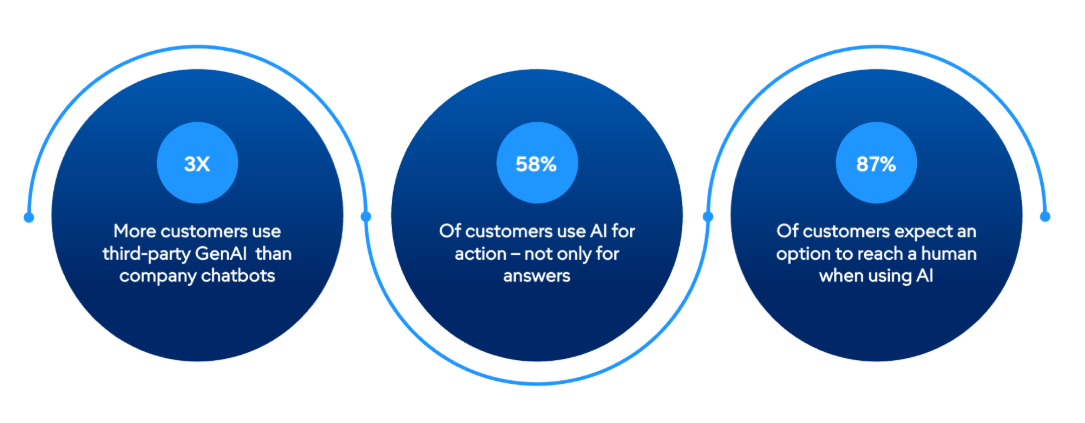
Third-Party AI Takes The Lead - Customers are three times more likely to use tools like ChatGPT or Claude than brand-owned chatbots, while adoption of company chatbots has remained flat since 2022.
Customers Want Action - More than 58% of consumers use generative AI to complete tasks, but many brand chatbots still only answer questions instead of helping users complete their journey.
Online Shopping Becomes Routine - Numerator found that two-thirds of U.S. households (86 million) now shop online weekly, with online purchasing expanding rapidly across grocery, restaurants, and household categories.
Stores Still Drive Discovery - Despite e-commerce growth, 55% of shoppers still discover products in physical stores, while 77% have used buy online, pick up in-store, showing digital and physical retail continue to work together.
Consumers are increasingly relying on third-party AI assistants instead of brand chatbots; brands here need to complete customer transactions within the same conversation, rather than redirecting users or answering questions.
👨💻 Quick Hits
💡 Your AI can talk email strategy all day, but it cannot open your platform, pull live data, and build the campaign while you watch. Omnisend MCP gives Claude or ChatGPT direct access to your live campaigns and automations, so the only thing left is saying go. Migration is free for 5 days, and your bill drops up to 35%. Connect Omnisend to your AI and run your first prompt today.
🌍 Instagram Reels now supports AI-powered translations in up to 18 languages, adding Japanese, Korean, French, German, and Italian while automatically translating audio, captions, and even syncing creators' lip movements to help reach global audiences.
🖼️ Google Images is getting a Pinterest-style redesign, introducing a personalized image feed, collections for saved inspiration, and AI-powered image generation that lets users create visuals from text prompts before searching.
💰 OpenAI’s $100B ChatGPT ads ambition faces a reality check, with Emarketer forecasting the entire U.S. chatbot advertising market will reach just $5.4 billion by 2030, highlighting the scale of adoption still needed.
🔗 Google’s John Mueller dismissed 'first-link priority' optimization, advising SEOs not to hide or obfuscate internal links just to influence anchor text, saying Google is already built to handle multiple links to the same page.
That’s a wrap for today! Tell us your thoughts about today's content as we line up more Shorts! And don’t hesitate to share this with someone who’d adore it. 🥰