
ChatGPT and Google Cite Differently
📚 ChatGPT and Google AI Mode are citing completely different sources, ChatGPT Ads are growing fast but nobody's cracked the playbook, and more!
Hey there Smarty 👋
Are you geared up to catch the latest and greatest in quick shorts?
And just a quick heads-up! If you stumbled upon us through a friend, make sure to subscribe here! That way, you’ll never miss out on the trending shorts.

📚 ChatGPT and Google AI Mode aren't reading from the same library
Semrush's own AI Visibility Index, analyzing 126 million US AI search prompts, found ChatGPT's leading citation sources are Reddit at 28.9% and Wikipedia at 23.1%, community and reference platforms.
Google AI Mode's leading sources are YouTube at 21.1% and Facebook at 17%, with nearly half of its citations coming from social and video content overall.
These aren't two engines drawing from the same pool with slightly different weighting. They're pulling from two different kinds of source material almost entirely.
That distinction matters more than a simple citation-count comparison, because it means the content strategy that earns citations on one platform can be close to irrelevant on the other.
A brand investing in community presence and reference-style content is optimizing directly for what ChatGPT favors and doing almost nothing for what Google AI Mode actually cites. A brand investing in video and social content has the reverse problem.
Map your current content investment against source type, not just platform
Most content strategies get planned by channel, blog content, video content, social content, without an explicit line connecting each type back to which AI platform actually cites it.
Categorize your last two quarters of content output by type: reference and community-style content versus video and social content. Compare that split against the citation-source split for whichever platform matters most to your category.
A heavy investment in one content type while the platform you're prioritizing cites the other is effort spent in the wrong place.
Build a genuine presence in community and reference spaces if you're chasing ChatGPT visibility
A brand with no active presence on Reddit or no maintained reference-style content, a solid Wikipedia entry, structured data, third-party reference listings, is missing the two source types ChatGPT relies on most, regardless of how strong its owned content is.
This isn't about gaming either platform. It's about recognizing that Reddit and Wikipedia function as trust signals ChatGPT weighs heavily, and a brand absent from both is starting from a real disadvantage on that specific platform no matter how good its website is.
Invest in video and social specifically if Google AI Mode visibility is the priority
Since nearly half of Google AI Mode's citations trace to social and video sources, a content plan built primarily around long-form written content is optimizing for a citation pattern that the platform doesn't follow as heavily.
Tracking citation source composition per platform, rather than treating "AI visibility" as one undifferentiated goal, is what Semrush's AI Visibility Toolkit is built to surface. You can try it free for 7 days.
Two AI systems can agree a brand matters and still be reading from completely different shelves to decide what to say about it.
Together with Billo
Get Meta’s Take Before Your Next Ad Test
Everyone has advice on what works in Meta ads. You’re the one paying when it doesn’t.
Get closer to the source before another campaign turns someone else’s theory into your expense.
On October 7 at 11:00 AM ET, Billo CEO Donatas Smailys hosts a free, 60-minute live session featuring Reyna Baker, Partner Manager at Meta.
You’ll get direct access to:
- Meta’s own data explaining why creator-handle ads are outperforming brand creative, so you can assess what Partnership Ads could bring to your account.
- Creative testing lessons from Curtis Howland, VP of Marketing at Misfit Marketing, who has managed $100M+ in Meta spend.
- Examples of how a marketing lead and an agency founder are scaling creator ads, giving you approaches to adapt to your campaigns.
You’ll leave knowing what to test with creator ads next, backed by Meta’s data and lessons from teams already running them.
Can't attend the session live? Register anyway, and you’ll get the recordings in 24 hours.
💬 ChatGPT Ads are growing fast, but nobody has cracked the playbook yet
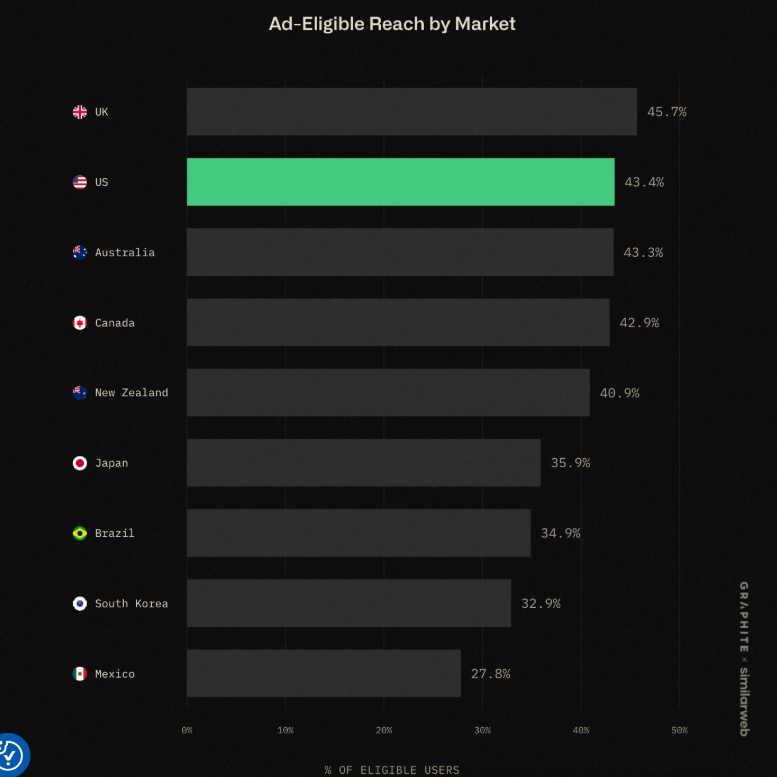
Six months in, ChatGPT Ads have reached 43% of ad-eligible U.S. users, while research covering 98,000+ ads shows advertisers are still testing everything from creative and timing to landing pages.
The Breakdown:
CTR Is Climbing - Click-through rates have roughly doubled since launch. U.S. CTR sits around 0.73%, while Brazil leads the nine markets studied at 1.91%, followed by Mexico and Japan above 1.5%.
ChatGPT Needs New Creative - Leading advertisers create 98% new copy specifically for ChatGPT, tailoring messages to conversational intent instead of simply importing Google or Meta campaigns.
Early Turns Work Best - Ads appearing within the first few exchanges of a conversation generate the strongest CTR and impression share. More creative variations also generally correlate with greater impression share.
Advertisers Are Still Experimenting - Only Jotform and Resume.io remained among the 10 largest advertisers across all 20 weeks studied. B2B SaaS currently represents the biggest U.S. category at 19.9% of impressions.
ChatGPT is developing into a distinct ad channel rather than a replacement for Google Search. The early playbook favors conversation-specific creative, simple high-intent landing pages and constant testing, especially as Amazon Ads, Shopify integrations and expansion into more than 60 countries bring more advertisers into the market.
👨💻 Quick Hits
🤖 Meta launched Muse for Small Business, connecting its AI agents with tools including Shopify, Slack, Canva, Stripe, and QuickBooks to help SMBs automate marketing, finances, customer communications, and business planning.
💬 Threads is expanding Live Chats with group emoji reactions, a raise-hand feature and web access, giving users more ways to participate in real-time text discussions around trending events, sports, and entertainment.
🛒 Amazon has blocked Meta’s Muse AI agent from shopping on its platform, citing its terms of service and concerns over agent identification and customer credentials, despite robots.txt offering no direct way to block Muse.
🛒 Shopify expanded WebMCP into checkout, letting browser-based AI agents update order details and complete purchases after buyer approval. Shopify says its tests made WebMCP 58% cheaper and over 2× faster than browser automation.
That’s a wrap for today! Tell us your thoughts about today's content as we line up more Shorts! And don’t hesitate to share this with someone who’d adore it. 🥰