
You’re using the wrong story order
⚖️ Some platforms convert faster when you tilt the sequence, AI shopping gets a holiday upgrade, and more!
Hey there Smarty 👋
Are you geared up to catch the latest and greatest in quick shorts?
And just a quick heads-up! If you stumbled upon us through a friend, make sure to subscribe here! That way, you’ll never miss out on the trending shorts.

⚖️ The Offer Tilt Method: How to Reorder VSL Segments for Psychological Impact
The classic VSL formula, Hook → Problem → Agitation → Mechanism → Solution → Proof → CTA—works. But sticking to it blindly is what’s killing your conversions.
Great marketers don’t follow formulas. They tilt them.
Because a VSL isn’t a story. It’s a sequence of psychological triggers, and depending on platform, audience state, and attention bias, you may need to flip the order to match how belief forms.
Let’s break the script
YouTube viewers might want emotional proof first. TikTok viewers need immediate contradiction. Instagram viewers? They don’t care unless the product hits them in the first 3 seconds.
When you treat a VSL like a static narrative, you lose the opportunity to meet the viewer where they are. Instead, think in conversion momentum, not narrative order.
Tilt examples that outperform the classic arc:
- TikTok: Discredit → Hook → Solution → CTA Start with tension: “Most serums lie about this…” Drop in a relatable hook, then reveal the product fast before the scroll.
- Instagram: Solution → Problem → Agitation → CTA Lead with the product in use. Then backfill the “why it matters” using visual contrast and emotional recall.
- YouTube: Testimonial → Agitation → Mechanism → CTAOpen with a true believer. Then draw out their initial skepticism and the science behind the switch.
Each tilt isn’t just structural, it’s context-aware. Built for how belief and attention unfold per channel.
Syncly = the Tilt cheat code
With Syncly Social, you can analyze TikTok’s untagged spoken brand mentions to find exactly which creator phrases signal purchase triggers, like:
“I actually bought this after watching 3 videos.”
“It looked like a scam, but I was wrong.”
“Didn’t think I needed it… now I use it daily.”
Those aren’t just testimonials. They’re sequence signals. You can book a call with Syncly Social’s founders and claim your free, in-depth TikTok analysis.
Final takeaway:
The story doesn’t need to change. The order does. Frameworks are starting points. Tilt is how you scale across platforms, attention spans, and belief thresholds.
Most brands tell a good story. The smart ones tell it in the right order.
Together with Fullcart
Your data knows what’s wrong, you just can’t see it.
You already have Shopify, Meta, and Klaviyo, but none of them talk to each other. So you waste nights trying to figure out why ROAS dipped or which ad is quietly burning cash. By the time you find the answer, the damage is already done.
Fullcart is the AI Operator that brings your data, ads, and ops together into one intelligent system that analyzes, answers, and fixes what’s broken before you notice.
📊 Connect Shopify, Meta, and Klaviyo to see every metric in one clean, real-time dashboard.
🤖 Ask anything like “Which campaign drives repeat buyers?” and get instant, analyst-grade answers.
⚙️ Automate ops to pause bad ads, sync inventory, or issue refunds without leaving your screen.
💡 Top teams save 8+ hours a week and make faster, higher-margin decisions.
Imagine waking up to one dashboard that knows what’s breaking, why, and how to fix it before you do. That’s Fullcart.
Try Fullcart free today and see how your data can finally start working for you!
🛍️ AI Shopping Gets Smarter
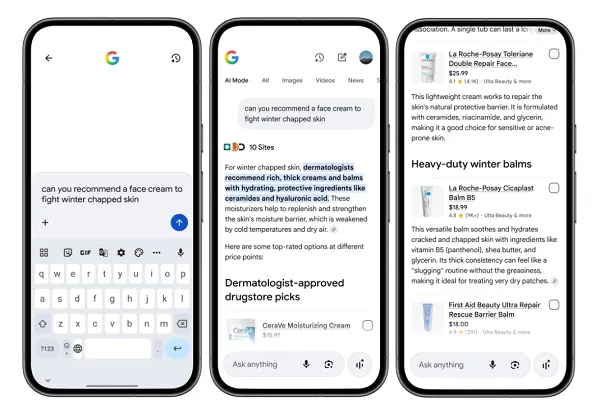
Google and Meta rolled out new AI upgrades that tighten the jump from discovery to action. Google leans into agentic shopping with guided comparisons, auto-buy features, and a new visual feed while Meta refreshes Marketplace with collaborative tools, AI-driven questions, and clearer checkout flows.
The Breakdown:
1. Conversational Discovery- Google’s upgraded AI Mode turns loose queries into visuals, reviews, prices, and tailored comparison tables. It adjusts to intent, from aesthetic searches to product-specific breakdowns, cutting browsing time dramatically, while the new Pinterest-style Images feed adds daily shoppable inspiration tied to user interests.
2. Agentic Shopping Tools - Google can now call stores, check stock, and send local inventory from multiple locations directly to the user, and the price tracking can also auto-buy items when they hit a chosen price. Gemini integration ties all of this to a 50B-item Shopping Graph for higher accuracy.
3. Smarter Buyer Guidance - Meta Marketplace now suggests AI-generated questions and offers insights for big items like cars, reducing uncertainty before messaging sellers, while the Reactions and comments feed clearer interest signals into ranking systems.
4. Social Shopping Utilities - Collections let users save listings into themed groups, while collaborative chats bring friends into shared decisions. AI-driven prompts make buyers more “expert,” though this adds pressure on casual sellers, and their new transparent checkout shows total costs upfront.
Google pushes deeper into agentic commerce while Meta formalizes peer-to-peer shopping with AI support. Inspiration, discovery, evaluation, and purchase are collapsing into faster, AI-led flows. These shifts signal a holiday season where platforms, not shoppers, will handle more of the decision-making and verification work.
🚀Quick Hits
😲 Your best-performing influencer campaign is already in your customer base. Stack Influence helps you activate real buyers to post, review, and drive rank, just like Lenny & Larry’s, who 11×’d sales with zero media budget. Book a call today and start compounding organic trust.
🔍 LinkedIn is rolling out AI-powered conversational search, letting users find people with natural language prompts. Premium members in the U.S. can now search using plain requests instead of filters.
🤖 Google’s new Ads Advisor AI shows early potential but remains unreliable, offering helpful suggestions alongside outdated guidance. Testers say it behaves like a capable but error-prone intern, requiring close human oversight.
📊 AI now drives just 1% of website traffic, with ChatGPT responsible for most referrals. Conductor’s report shows organic search still dominates, while AI platforms surface different brands than Google.
🎥 Google is testing a PMax feature that surfaces social video ads via Pathmatics, helping reuse high-performing creatives. The experiment streamlines setup but raises data permission and transparency concerns.
That’s a wrap for today! Tell us your thoughts about today's content as we line up more Shorts! And don’t hesitate to share this with someone who’d adore it. 🥰