
You’re reading PMax wrong
💪 Delivery reflects certainty, not strength, what 2025 data reveals about Google’s AI search rollout, and more!
Hey there Smarty 👋
Are you geared up to catch the latest and greatest in quick shorts?
And just a quick heads-up! If you stumbled upon us through a friend, make sure to subscribe here! That way, you’ll never miss out on the trending shorts.

Together with Lindy
You are not behind on ideas. You are behind on speed.
You know the drill. Competitor research scattered across tabs, unfinished messaging docs, late briefs, and creative that misses the angle. That chaos is not annoying; it is expensive.
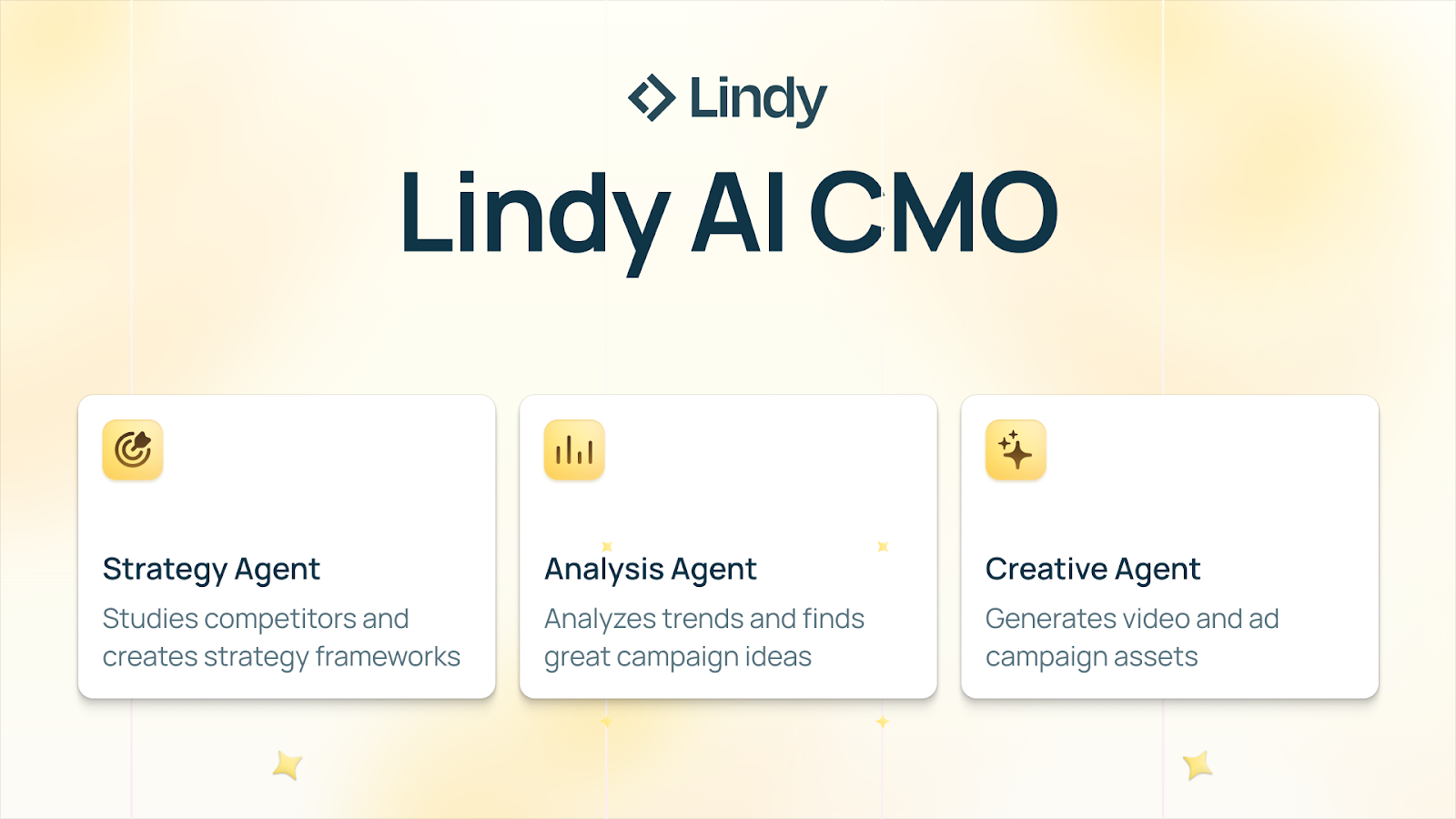
Lindy AI CMO is a suite of powerful agents that ship beautiful marketing campaigns quickly.
Drop in your website, and agents study your competitors, extract angles, draft messaging, create briefs, and generate launch-ready assets, then organize everything in Airtable for a clean approval flow.
- Cut campaign prep from 10 to 14 days down to 1 to 2 days.
- Generate 30 to 80 on-brief variants per angle to accelerate testing.
- Reduce rework and increase weekly experiment volume without extra headcount.
Teams running agent-led workflows consistently ship 2 to 3 times more weekly tests with the same headcount.
💪You’re Reading PMax Wrong
Google didn’t give advertisers clarity. It gave them context.
And that distinction matters more than most teams realize.
The new reporting around Performance Max is being treated like a truth machine. People are scanning rows, comparing channels, drawing conclusions, and reallocating budgets as if the system is finally explaining itself.
It isn’t. What it’s actually doing is exposing how comfortable the algorithm feels with the inputs you’re feeding it. That’s a very different lens.
The Real Question Isn’t “Which Channel Won”
Performance Max doesn’t wake up and decide to favor Search, Display, or YouTube.
It decides which inputs feel predictable.
When certain formats dominate delivery, it’s not because they’re “better.” It’s because they’re safer. Feed-driven ads, for example, remove ambiguity. The system understands products, prices, and intent patterns with fewer unknowns.
Asset-heavy creative introduces interpretation. Interpretation introduces risk. So when you see delivery skew, what you’re really seeing is the model hedging.
Why most advertisers will misread this data
The temptation is to optimize toward whatever shows the cleanest numbers. That’s how accounts slowly collapse.
Because performance isn’t coming from where spend flows. It’s coming from where confidence already exists.
The report doesn’t tell you where to invest more. It tells you where the system stopped trusting you to experiment. That’s a warning sign, not a victory lap.
The move you should make:
Don’t try to “fix channel mix.” Audit creative certainty.
- Which assets remove friction?
- Which ones introduce hesitation.
- Which ones does the system test briefly, then abandons?
Those drop-offs are more valuable than the winners. They reveal where your messaging forces the algorithm to guess.
What does this change about operating PMax
Performance Max isn’t a channel strategy anymore. It’s a signal hygiene problem. If your assets are clean, specific, and interpretable, the system expands. If they’re vague, clever, or overproduced, it retreats to what it already understands.
The reporting didn’t unlock control. It exposed accountability. And that’s uncomfortable for teams still treating automation like a shortcut instead of a mirror.
🔍 AI Overviews Are Rewriting Search Behavior
New research from Semrush shows how quickly Google’s AI Overviews are reshaping search visibility, intent, and click behavior. What started as a low-risk experiment is now moving deeper into commercial and navigational territory.
The Breakdown:
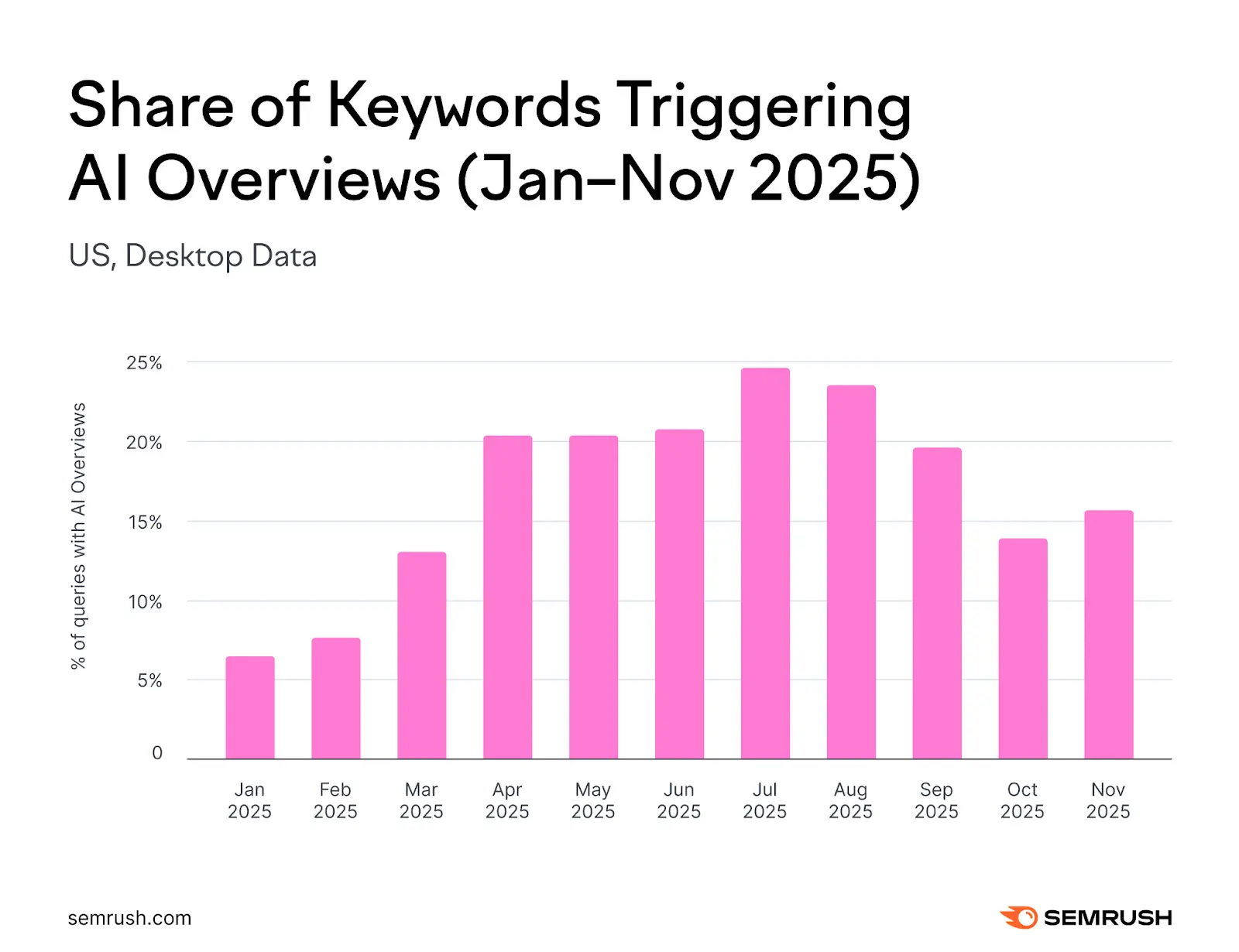
1. Volatile Adoption, Not Linear Growth - AI Overviews appeared on just 6.49% of keywords in January 2025, surged to nearly 25% by July, then settled at 15.69% in November, suggesting Google is actively tuning scope rather than rolling out AIOs evenly.
In January, 91.3% of AIO-triggering queries were informational, but by October, that fell to 57.1%. Commercial queries rose from 8.15% to 18.57%, transactional from 1.98% to 13.94%, and navigational from 0.74% to 10.33%.
2. Click Behavior Is More Nuanced Than Expected - While AIO queries skew toward historically zero-click searches, zero-click rates actually declined after AIOs appeared. For the same keywords, zero-click rates dropped from 33.75% to 31.53%.
AI Overviews now almost always appear alongside People Also Ask (90.03%) and Related Searches (95.32%). Google Ads at the bottom of AIO SERPs jumped from under 1% to 25%.
AI Overviews are reshaping visibility, intent, and SERP structure, but Google’s position is that the fundamentals have not changed. Its leadership continues to stress that optimizing for AI search mirrors traditional SEO, with strong sites, clear structure, and genuinely useful content remaining the core strategy for earning visibility.
Together with The Shift
Turn AI from “Interesting” to “Impactful”
If you’ve ever thought, “That’s cool, but how would I actually use it?”
The Shift is for you. Here’s what you’ll get:
- Easy-to-follow breakdowns of even the most complex AI concepts.
- Real strategies you can apply in minutes, no tech degree required.
- Bonus access to 2,000+ AI tools, free courses, and prompt libraries.
Every edition is built for action, so you can improve campaigns, speed up workflows, or launch ideas faster than ever before.
You don’t just “learn AI” here. You make it work for you.
🚀Quick Hits
📱 X has launched a new mobile Creator Studio hub, giving creators one place to track revenue, subscriptions, analytics, payments, support access, and top-performing posts for inspiration.
📉 Microsoft says duplicate content now hurts AI Search visibility too, because LLMs struggle to understand which version to trust, summarize, or surface, making clear intent and consolidation more critical than ever.
📱 TikTok has reportedly signed a $14 billion deal to keep operating in the U.S., agreeing to spin its U.S. business into a joint venture led by Oracle, Silver Lake, and MGX ahead of the Jan 23 deadline.
🎥 Google’s Gemini can now detect SynthID watermarks in videos up to 90 seconds, telling users whether visuals or audio were generated with Google AI
That’s a wrap for today! Tell us your thoughts about today's content as we line up more Shorts! And don’t hesitate to share this with someone who’d adore it. 🥰