
Wit doesn’t pay the bill
✍️ Your cleverest copy is killing your click rate, Google & Instagram are rewriting discovery, and more!
Hey there Smarty 👋
Are you geared up to catch the latest and greatest in quick shorts?
And just a quick heads-up! If you stumbled upon us through a friend, make sure to subscribe here! That way, you’ll never miss out on the trending shorts.

✍️ Your Cleverest Copy Is Killing Your Click Rate
The headline tested well in the room. Everyone liked it. Witty, on-brand, made the copywriter feel good.
It converted at half the rate of the boring version.
This happens constantly. The reason is simple enough to be embarrassing once you see it.
Every clever word is a micro-pause.
When copy requires interpretation, the brain stops, decodes, confirms, then decides what to do next. That pause is invisible in a copy review. It's very visible in your click rate.
Clever copy earns that pause when the reader is already invested, in a long-form piece, a brand they love. In a CTA or subject line, they're scanning. Deciding in milliseconds. A micro-pause at that moment isn't a stylistic choice. It's friction at exactly the moment you need it least.
"Discover your glow" asks the reader to interpret. "Shop the vitamin C serum" tells them what happens next. Clarity isn't dumbing it down. It's removing the cognitive load between your reader and the action you want them to take.
Brands keep writing clever CTAs for the wrong audience.
Most copy gets written for two audiences simultaneously: the customer and the internal team. The customer needs clarity. The internal team rewards wit, voice, and originality. A CTA that sounds like the brand gets approved faster than one that just works.
So copy optimizes for the approval, not the click.
Someone deciding whether to buy skincare at 11 PM on their phone is not in the headspace to appreciate a clever turn of phrase. They want to know what they're clicking, what they're getting, and why it's worth it. In that order.
Subject lines and CTAs have completely different jobs.
A subject line earns the open from someone with zero context. Curiosity works here, not wordplay, but genuine intrigue. "We found the problem" outperforms "Your weekly newsletter" because it creates a reason to open.
A CTA earns the click from someone who already read your argument. Curiosity is the wrong tool at this stage. They need a clear path forward. Ambiguity here betrays everything that came before it.
Clever subject line. Clear CTA. Mix them up and you pay for it at whichever stage you get wrong.
The one-question fix.
Ask: what does the reader actually get when they click?
"Learn more" becomes "See how the formula works." "Discover your glow" becomes "Shop the vitamin C serum." Replace the action with the outcome and friction disappears.
Syncly Social helps close the loop, picking up spoken and untagged brand mentions across TikTok, Instagram, and YouTube. The words your customers use unprompted are the clearest signal for what belongs in your copy. You can get started for free here.
Clarity isn't a creative limitation. It's the highest-leverage edit you can make.
Together with Delve
Migrate to Delve and get a $2,000 VISA card in your inbox
Delve is the AI-native compliance platform that actually does the work for you, auto-collecting evidence from AWS, GitHub, and your stack so you don't have to chase screenshots or babysit integrations.
Use AI security questionnaire tooling, AI Copilot, and everywhere else to make compliance feel less dreadful. Welcome to the new age.
The proof is in the pudding:
Bland → Switched, got compliant, and unlocked $500k ARR in 7 days
11x → Streamlined audits and moved faster on enterprise deals
micro1 → Scaled compliance without adding headcount.
Bonus: Delve will handle your migration for free. Zero-touch. No disruption. No starting over.
If you're dreading opening your current SOC 2 tool, that's your sign.
🛍️ Google & Instagram Are Rewriting Discovery
Two quiet tests. Two very different shifts. Google is moving Shopping ads up the funnel. Instagram is finally letting creators push traffic out. Both changes point to the same thing. Platforms want more control over where attention goes next.
The Breakdown:
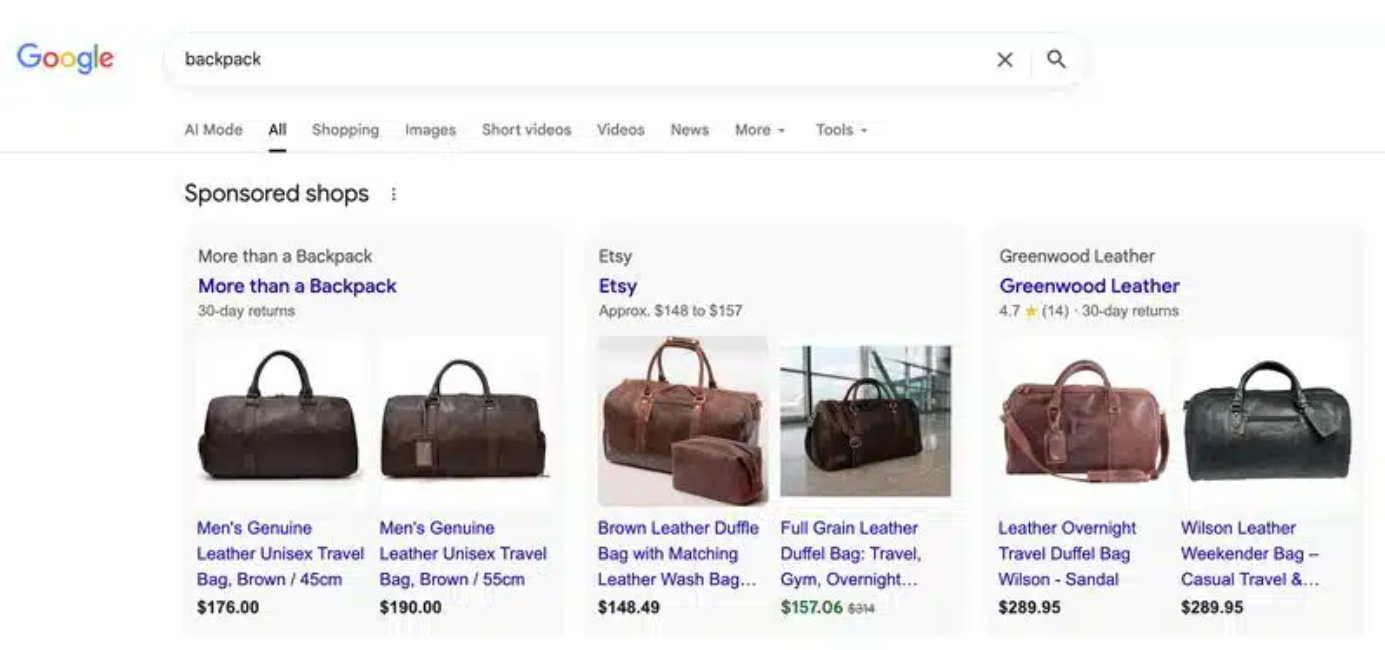
1. Stores Over SKUs - Google is testing “Sponsored Shops,” where entire stores appear instead of single products. That means brands no longer win with one great listing; they win with a strong overall catalog.
2. More Paths, More Power - These units include multiple products, store names, and ratings in one block. Instead of one click per ad, users now have several entry points, which could reshape how traffic splits between product pages and storefronts.
3. Links Finally Land - Instagram is testing links in post captions, but only for Meta Verified creators. Each creator gets a limited number of links per month, making this feel more like a premium feature than a universal rollout.
This isn’t just product updates. Google is turning Shopping into storefront discovery. Instagram is turning creators into traffic channels. And in both cases, the game is shifting from single actions to full ecosystems.
🚀Quick Hits
📢 Meta is replacing “Sponsored” with a smaller “Ad” label in feeds, aiming for a cleaner look, but potentially making ads less noticeable and impacting user awareness, performance, and regulatory scrutiny.
📊 OpenAI is testing an Ads Manager for ChatGPT, building a new ad ecosystem, but early results show lower performance than Google, meaning it must prove ROI before becoming a serious advertising channel.
🧠 LinkedIn is rebuilding its feed with AI-powered ranking models that better understand content and user behavior, delivering faster, more relevant posts while reducing engagement bait and outdated recommendations.
🚗 Meta is replacing Nielsen DMA with ComScore Markets data for auto ads by June 2026, changing how regions are defined and potentially impacting targeting accuracy and campaign performance.
🪩Events
🚀 Ever Wonder Why Some Brands Never Run Out of Winning Ideas?
Starts Today | Tuesdays at 1 PM EST | Virtual Bootcamp
They aren’t “more creative.” They use an internal idea-generation system that produces high-leverage angles on demand. Motion’s free 8-week program teaches that system step-by-step, live, the same one operators at Calm, Harry's, and Happy Mammoth use daily. This is the closest thing to joining their team.
Can't attend every session live? Register anyway, you'll get the recordings within 24hours.
That’s a wrap for today! Tell us your thoughts about today's content as we line up more Shorts! And don’t hesitate to share this with someone who’d adore it. 🥰