
When Scale Breeds Fragility
🥲 Why scaling ads creates hidden inequality in your portfolio, The new era of social strategy, and more!
Hey there Smarty 👋
Are you geared up to catch the latest and greatest in quick shorts?
And just a quick heads-up! If you stumbled upon us through a friend, make sure to subscribe here! That way, you’ll never miss out on the trending shorts.

🥲When Scale Breeds Fragility
Every operator has seen it: the dashboard looks perfect, the numbers sing, and for a moment, it feels like everything’s working. Spend is up, ROAS is holding, and revenue charts look clean.
But hidden inside that calm is the start of something dangerous. A few ad sets begin compounding wildly while the rest stall. You think you’re scaling your system, but you’re actually scaling your inequality.
How It Quietly Starts
Scaling doesn’t distribute performance evenly. When budgets rise, algorithms double down on what’s already winning. Three things start happening:
- Creative concentration: A few ads dominate exposure and steal oxygen from everything else.
- Offer stagnation: Old angles keep getting fed while new tests never mature.
- Algorithmic bias: Delivery systems start preferring predictability over exploration.
It’s a feedback loop disguised as success. Every incremental dollar reinforces the same narrow cluster of performance until the system loses adaptability.
The Mirage of Healthy Averages
Averages are the comfort zone of the unaware operator. A portfolio showing +25% growth might look solid, but look deeper and you’ll find 70% of the revenue is driven by just a handful of assets.
That imbalance isn’t visible in standard dashboards; they’re built to report output, not distribution health.
This is where tools like Fullcart become critical. Instead of showing you what performed, it tells you why certain assets are overperforming.
By cross-mapping Meta, Shopify, and Klaviyo data, it exposes creative concentration early, before efficiency collapse reaches your P&L. You can try Fullcart free today and see how your data can finally start working for you.
Breaking Out of the Bias Loop
The fix isn’t to kill losers; it’s to re-engineer exposure. Operators who scale sustainably treat discovery as an operational KPI. Some rules that separate them:
- Cap creative concentration at 40% of total spend.
- Run structured diversification cycles every 30 days.
- Launch “counterweight” campaigns that challenge your top performer’s audience overlap.
- Measure variance as a health metric, low variance equals fragility.
This approach keeps your system breathing evenly, ensuring you’re scaling stability, not just performance.
The Operator’s Mindset
True growth isn’t found in spikes; it’s maintained in balance. Polarization isn’t always bad, it’s a signal. But your job is to recognize when momentum turns into monopoly.
The best operators don’t chase short-term glory; they manage systemic health. They know that scaling is only sustainable when the whole machine grows, not just its loudest parts.
Together with Semrush
The Data’s Clear. Here’s How E-commerce Actually Changed.
The Semrush × Statista 2025 Ecommerce Report analyzed billions of visits and sales signals across 190 markets, and the data points to a full reset in how people buy, click, and convert.
Here’s what’s reshaping marketing playbooks right now:
• Video-led landing pages convert 42% higher than static ones; attention now drives trust.
• 46% of shoppers buy from the first brand they click, making recall a revenue lever.
• AI-generated shopping queries are growing 8× faster than organic.
These shifts are reshaping the fundamentals: tariffs redirecting traffic, U.S. retailers gaining share, and paid search reclaiming top performance.
Download the full playbook to see what these shifts mean for your marketing strategy.
📈 Inside the Future of Social Marketing
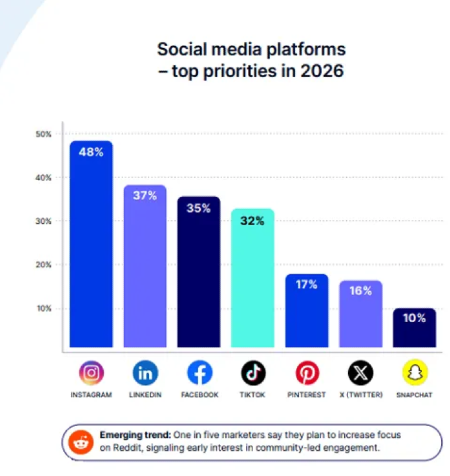
Marketers are heading into 2026 blending AI, creator partnerships, and community-led engagement. The Emplifi report highlights how these shifts are redefining performance priorities across major social platforms.
The Breakdown:
1. AI Integration - 82% of marketers now use AI, mainly for analytics (30%), content creation (28%), and ad targeting (26%). Only 35% report major productivity gains, signaling unrealized potential. Instagram (48 %) and LinkedIn (37%) remain the top AI-driven focus platforms.
2. Influencer Growth - 67% plan to boost influencer budgets in 2026, with micro and macro creators (47% each) leading impact. Campaigns focus on brand awareness (70%) and community growth (49%). 65% of consumers say relatable creators drive their purchase decisions.
3. UGC Expansion - 82% of marketers value UGC, but only 31% scale it effectively due to quality and ROI measurement gaps. With 30% citing content sourcing as the main challenge and 24% struggling to track returns, brands are turning to structured UGC, campaigns (28%), influencer UGC (25%), and customer videos (23%).
4. Platforms and Formats Rebalance Power - Instagram (48%) leads storytelling, LinkedIn (37%) drives thought leadership, and TikTok (32%) fuels discovery and authenticity. Short-form video (73%) dominates, performing best when it is fast and authentic.
The key theme for 2026 is diversification. As marketers spread efforts across platforms, automation, AI scheduling, and analytics ensure efficiency without burnout. Success will depend on tailoring short-form storytelling to each platform rather than cross-posting identical content.
🚀Quick Hits
🦘 Legacy clouds penalize momentum with hidden costs and queues. Nebius fixes both: predictable $2/hr pricing, 50% faster model training, and zero downtime. Teams like Captions already made the jump. Get your 3 free months now.
📌 Pinterest hits 600 million monthly active users, up 22 million from last quarter, and reports a 17% year-over-year revenue rise. The platform’s AI-driven shopping tools continue to fuel discovery and e-commerce growth.
🤖 Snapchat is integrating Perplexity AI into user inboxes in early 2026, letting Snapchatters ask questions and get verified, conversational answers in-app. The $400M partnership adds a second AI chatbot alongside Snap’s existing My AI.
📹 Google Merchant Center now features a “Creative Content” tab where brands can upload and link video assets to products. Videos sync with Google Ads libraries, boosting visibility and streamlining creative management.
📉 LLM referral traffic rose 65% since January but plunged 42% since July. ChatGPT’s router now shows fewer citations, making visibility, not clicks, the new success metric for brands.
That’s a wrap for today! Tell us your thoughts about today's content as we line up more Shorts! And don’t hesitate to share this with someone who’d adore it. 🥰