
The Customer Creation Play Nobody Uses
🔥 Why customer creation outperforms targeting every single time, The 2025 social app landscape, and more!
Hey there Smarty 👋
Are you geared up to catch the latest and greatest in quick shorts?
And just a quick heads-up! If you stumbled upon us through a friend, make sure to subscribe here! That way, you’ll never miss out on the trending shorts.

Together with Stack Influence
How This Brand 11X’d Revenue Without Spending More on Ads
Ever launched a product that completely flopped despite perfect targeting and creative? That was Lenny & Larry’s with their Protein Pretzels until they flipped the entire playbook.
Using Stack Influence, they activated 1,560 real buyers who posted, reviewed, and shared authentic UGC. Each post built trust, drove rank, and triggered the algorithm’s flywheel.
Within weeks, sales didn’t just climb, they exploded:
- 11X increase in monthly sales (1K → 11K units)
- 500+ verified reviews boosting organic visibility
- $2M+ revenue created with zero extra ad spend
Stack Influence helps brands like Unilever and Magic Spoon scale the same way by turning real customers into micro-influencers and paying them only with products.
See how Stack Influence can 5X your revenue in 2 months!
🔥 Customer Creation as an Operating System:
Most DTC brands still treat “creating customers” as a poetic idea, something cute Peter Drucker said once, and everyone claps for at conferences.
But Drucker wasn’t being poetic. He was being literal.
“Creating customers” is not marketing. It’s not positioning. It’s not storytelling.
It’s an operating system, a way of thinking that shapes product, experience, messaging, and growth, and when you study the brands that bend culture, Apple, Crocs, Red Bull, Oura, Tesla, SpaceX, they all operate from the same truth: They don’t find customers.
They produce them. That’s the shift most DTC brands have never made.
1️⃣ Demand Genesis: Creating Desire Before It Exists
Most brands chase category intent. Customer-creation brands generate intent by teaching people what to want.
They don’t ask: “What’s the market size?”
They ask: “What behavior could exist that doesn’t yet?”
Think:
• Oura → “I want to track recovery, not steps.”
• Liquid Death → “Water can be a rebellion.”
• Crocs → “Comfort is a flex.”
• Dyson → “A vacuum is a status symbol.”
This is demand genesis, desire invented from the worldview, not search volume.
2️⃣ Desire Amplification: Transforming Curiosity Into Commitment
Once a new desire enters culture, these brands amplify it using two levers:
A. Mythmaking
Not myths as lies, myths as meaning. Red Bull with extreme performance. Tesla with the future. Crocs with anti-fashion. A myth gives customers a story to join.
Stories create emotional surface area for enrollment.
B. Language Engineering
New behavior needs new vocabulary. Think:
• “Close your rings.”
• “Recovery score.”
• “Energy multiplier.”
• “Deep work.”
Language creates identity. Identity creates repeat customers.
3️⃣ Ritual Adoption: Turning Products Into Behavior
Brands that create customers don’t sell items; they sell rituals.
A ritual has: a time, a place, a reason, a payoff
Athletic Greens isn’t a supplement. It’s a morning ritual. Stanley isn’t a bottle. It’s a daily carry ritual. Dyson isn’t a vacuum. It’s a cleaning ritual.
Ritual = habit.
Habit = revenue predictability.
This is the part most DTC brands miss. They sell ingredients and features, not behaviors.
4️⃣ Identity Lock: The Final Stage of Customer Creation
At this point, it stops being a product. It becomes a piece of who the customer is. Identity lock happens when:
- The brand validates a belief
- The product reinforces the belief
- The experience rewards the belief
- The customer broadcasts the belief
This is why created customers become evangelists, not shoppers.
Great brands don’t optimize for ROAS. They optimize for identity reinforcement. Identity lock is the moat performance brands wish they had.
The Shift: From “Who Can We Target?” to “Who Can We Create?”
Most DTC brands are still hunting for “people who want what we sell.” The next wave of dominant brands asks something far more powerful:
“How do we build the worldview, ritual, and identity that make our product inevitable?” Because the brands that create customers don’t compete on CPMs, CAC, or ad hacks.
They compete on beliefs. They compete on meaning. They compete on identity gravity. And that kind of gravity is immune to platforms, algorithms, and competitors.
📱 Social Media Usage Trends 2025
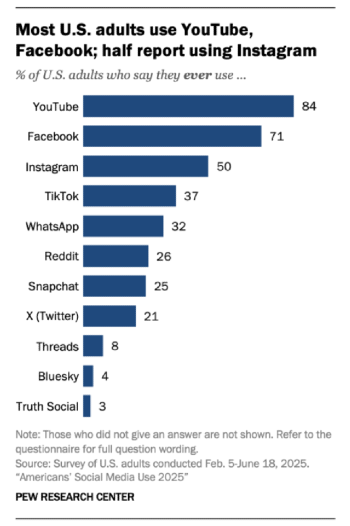
Pew Research surveyed 5,022 US adults to understand which social platforms people say they “ever use,” meaning they have used the app at any point. This measures overall reach rather than time spent or preference.
The Breakdown:
1. Largest Platforms Hold - YouTube is used by 84% of US adults, and Facebook by 71% which keeps both at the top of the list. Around half of adults visit each platform daily, which shows how often they are opened. Facebook sees 37% checking several times a day, while YouTube sees 33% doing the same.
2. Mid-Tier Platforms Rise - TikTok usage has increased from 21% in 2021 to 37% in 2025, according to the survey. Instagram has grown from 40% to 50% making it the only platform beyond YouTube and Facebook to reach half of US adults. WhatsApp at 32% and Reddit at 26% also show upward movement across multiple years.
3. Younger Adults Diverge - Among adults aged 18–29, 80% use Instagram compared with 19% of adults aged 65. Roughly 50% of adults aged 18–29 use TikTok daily compared with 5% of adults 65 and older. A majority in this age group also visits YouTube daily, with 54% reporting at least one visit per day.
The report highlights how YouTube and Facebook maintain the widest reach and the highest daily use among US adults. Platforms like TikTok, Instagram, WhatsApp, and Reddit continue to rise, especially among younger users.
Together with Athyna
The $100K Visa Shock Changing Tech Hiring
The H-1B just got expensive, and innovation can't wait.
💡 U.S. companies are turning to Latin America for world-class tech talent
🌎 Same time zones, strong English, zero visa drama
⚡ Build distributed teams that move faster and cost up to 60% less
🚀Quick Hits
🍌 Google just launched Nano Banana Pro, a major upgrade to its AI image generator with 4K outputs, legible text, multi-image consistency, and brand-safe visual editing. It supports up to 14 images and embeds SynthID for AI transparency.
🌀 Meta just unlocked the next phase of its metaverse push, rolling out SAM 3D object generation and expanding Hyperscape so anyone can scan real environments into VR and invite up to 8 people inside.
🔍 LinkedIn denies gender bias after viral tests showed women getting up to 700% less reach than male profiles, saying feed visibility ignores demographics, blaming timing, competition, and user behavior instead.
📈 Cyber Week 2025 is on track for a record $334B in global online sales, Salesforce reports. AI and shopping agents will drive $73B, while mobile orders hit 70% and TikTok traffic jumps 86%.
That’s a wrap for today! Tell us your thoughts about today's content as we line up more Shorts! And don’t hesitate to share this with someone who’d adore it. 🥰