
The best post-purchase flow ever
💪A post-purchase flow built for ltv, not receipts, Bing shapes ChatGPT while humans still win Google, and more!

Hey there Smarty 👋
Are you geared up to catch the latest and greatest in quick shorts?
And just a quick heads-up! If you stumbled upon us through a friend, make sure to subscribe here! That way, you’ll never miss out on the trending shorts.

💪 A Post-Purchase Flow Built for LTV, Not Receipts
The average ecommerce brand sends two emails after a purchase. One confirms the order. One says thank you. Both read like a receipt. Neither does it do anything for retention.
The problem isn't volume. Brands that graduate to seven-email sequences make the same mistake at scale: every email is the brand talking to the customer, optimizing for its own anxiety about churn.
The pre-fulfilment upsell thirty minutes after checkout is the clearest symptom. The customer just committed their money. The brand's response is to immediately ask for more.
What actually drives LTV isn't follow-up frequency. It's certain. A buyer who feels certain they made the right call doesn't need to be retained. They retain themselves.
Certainty, not engagement, is the real retention lever
Buyer's remorse starts within minutes of purchase and compounds at every point of silence. Every customer moves through a predictable sequence of internal doubts: Did I spend my money right? Will this work for me? What if I'm the exception? Most brands leave those questions unanswered and wonder why repeat purchase rates sit below 20%.
The Certainty Ladder is a seven-email sequence where each touchpoint has a specific psychological job tied to the customer's internal state at that moment, not a revenue target tied to the brand's calendar.
Seven emails. Seven psychological jobs.
- The Confirmation sends immediately and does one thing: tells the customer they didn't make a mistake.
- The Social Proof Preload goes out an hour later, not an upsell, but a real customer story mirroring the buyer's situation. Identity installation before the product arrives.
- The Founder Note follows two to four hours in, not to say thanks, but to explain why the product exists. Story at this stage creates irrational loyalty.
- The Expectation Setter on day one proactively answers "is this working?" before the customer asks, removing the single biggest trigger for returns.
- The Enemy Frame on day two reframes what the customer was doing before they bought as the actual problem. When returning to old behavior feels like regression, that's identity-level retention. No discount required.
- The Ritual Install ships at fulfilment alongside the tracking link, turning the unboxing moment into active first use. If you're running sequences like this, Omnisend makes the automation side effortless, $79 revenue per $1 spent, with 69% running on autopilot. You can try Omnisend for free
- The Progress Anchor arrives two days post-delivery with one direct question. Replies identify loyalists. The act of answering is itself a commitment.
What the sequence is actually doing
Repeat purchase is the output of loyalty, not a well-timed push. Every email in a standard flow asks a question about the brand's future with the customer. Every email in the Certainty Ladder answers a question the customer is already asking themselves.
Together with AirOps
Google rankings won't save you in AI search.
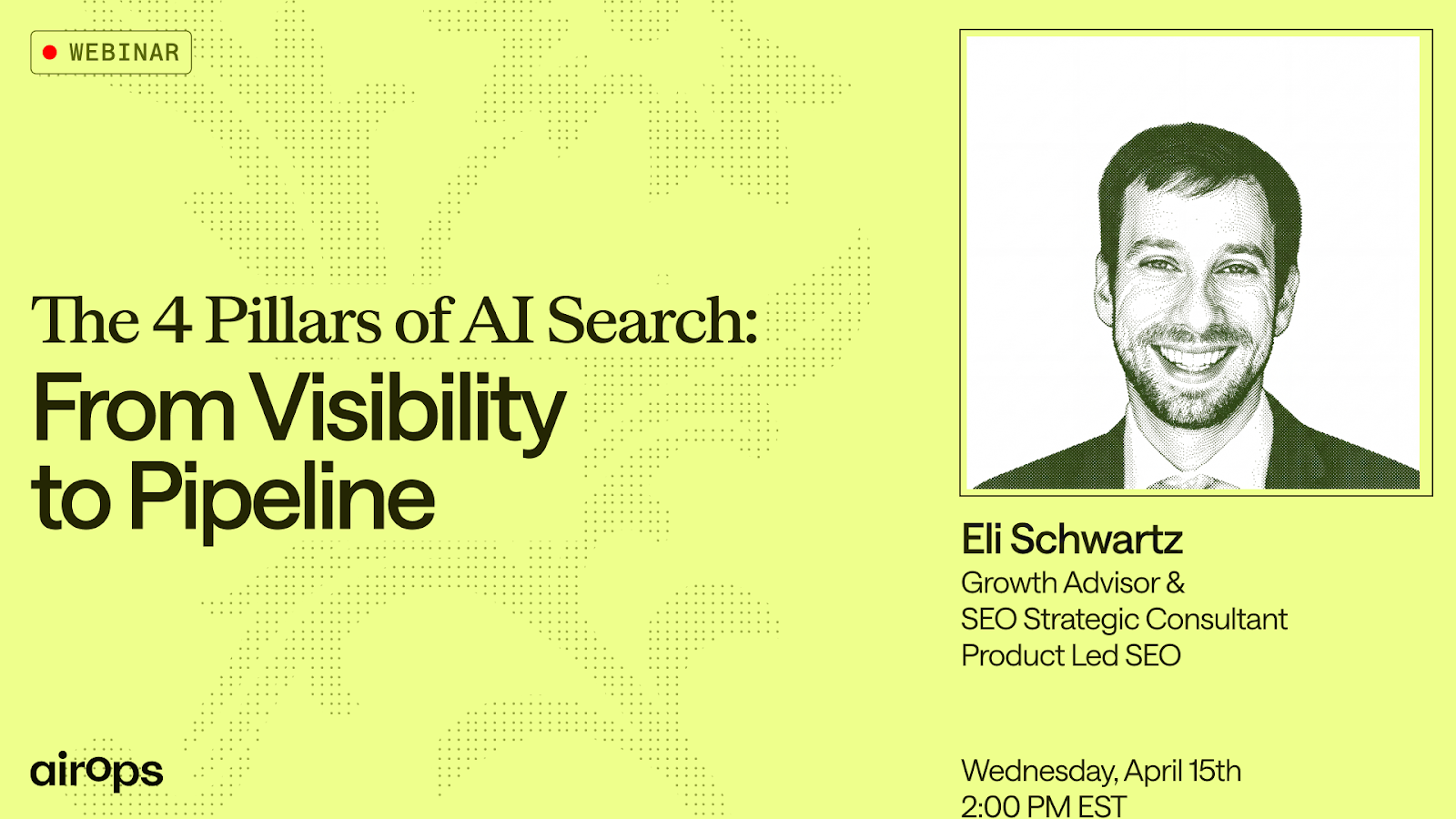
Google rankings don't matter if AI never pulls your content. And most brands have no idea why they're being skipped or how to change it.
On April 15th, Eli Schwartz is breaking down the exact framework he's taken into board rooms and VC meetings.
Eli has generated billions in organic search revenue for companies like Coinbase, LinkedIn, and Tinder. This is what he's telling them right now about AI search in 2026.
You'll walk away knowing:
- The 4 pillars that determine whether AI retrieves your content
- How to spot the highest-leverage SEO stages to fix first
- Why customer research is still the most underused edge in AI visibility
One live session. A framework you can action the same week.
Can't make it live? Register anyway and get the recording within 24 hours.
🔍 Bing shapes ChatGPT while humans still win Google
Two studies reveal how visibility works differently across AI and search. One shows ChatGPT depends heavily on Bing for brand recommendations. The other proves human-written content still dominates top Google rankings despite widespread AI adoption.
The Breakdown:
1) ChatGPT visibility depends more on Bing than Google - The study found that even strong brands can disappear from ChatGPT responses if they lack presence in Bing. Google rankings alone do not guarantee visibility in AI-generated recommendations.
2) Third-party content and Bing mentions drive AI exposure - Brands that appear in Bing articles and third-party content are more likely to be recommended by ChatGPT. Visibility depends on broader digital presence, not just direct website rankings.
3) Human content dominates top Google rankings - Semrush data shows human-written content ranks #1 far more often than AI content, with humans holding the top spot around 80% of the time compared to just 9% for AI pages.
4) AI helps scale content but does not guarantee quality - Most teams still rely on humans alongside AI, using it mainly for research and drafting. While AI speeds up production, it rarely improves content quality or replaces human judgment.
Search and AI are now playing by different rules. If you want to win Google, you need strong human content. If you want to win ChatGPT, you need visibility where the model is actually looking.
🚀Quick Hits
📺 Seed Health matched their digital CAC on TV within 6 weeks of running with Tatari, and conversions doubled week over week while their Meta costs kept climbing. Every dollar ties back to real site visits and revenue across linear, streaming, and direct inventory from one place. Schedule a free demo and see what TV looks like for your numbers.
🚀 Meta is preparing to launch new AI models led by Alexandr Wang, marking the first major output from its Superintelligence team as it pushes to compete at the highest level in AI.
📉 Instagram chief Adam Mosseri confirmed that reposting feed posts to Stories does not boost reach, emphasizing that most “growth hacks” don’t work and creators should focus on audience relevance instead.
🎯 Google’s John Mueller slammed self-proclaimed “SEO gurus,” calling them “clueless impostors” and reinforcing that SEO is constantly evolving, with no one having complete knowledge.
⚖️ Amazon is facing a lawsuit from creators who allege it scraped YouTube videos without consent to train its Nova Reel AI model, raising major copyright and data usage concerns.
That’s a wrap for today! Tell us your thoughts about today's content as we line up more Shorts! And don’t hesitate to share this with someone who’d adore it. 🥰