
January isn’t a new beginning
✋ It’s stopping things from following you forward, AI took over holiday support, and more!

Hey there Smarty 👋
Are you geared up to catch the latest and greatest in quick shorts?
And just a quick heads-up! If you stumbled upon us through a friend, make sure to subscribe here! That way, you’ll never miss out on the trending shorts.

🗓️ January isn’t a New beginning
January doesn’t make people ambitious. It makes them permissive.
For a short window, people loosen the rules they normally live by. Spending rules. Habit rules. Identity rules. The internal arguments that block decisions for the rest of the year temporarily quiet down.
Not because motivation spikes, but because justification becomes easier.
Throughout the year, most purchase decisions run into resistance that has nothing to do with price or product quality.
“I don’t need this right now.”
“I’ll think about it later.”
“I should probably stick with what I already have.”
January disrupts that loop.
The calendar itself becomes a reason. A socially acceptable excuse to reconsider things that felt settled in November. The same decision doesn’t feel impulsive anymore. It feels intentional.
That’s the Permission Window.
This is why January ads fail when they try to manufacture desire.
People aren’t looking to be convinced they want something new. They’re looking for validation that changing something makes sense now.
The brands that win in January don’t push harder. They explain better.
They give people language for decisions they were already considering but couldn’t justify before.
Removing something unhealthy. Simplifying something bloated. Stopping a habit that quietly feels wasteful. Choosing an easier default. These aren’t aspirations. They’re relief narratives.
This is also why creator-led ads outperform polished brand promises in January. Seeing someone similar make the change first lowers the internal friction to say yes. Platforms like Insense help brands tap into this moment by matching them with brand-aligned creators whose UGC feels like permission, not persuasion.
You can book a discovery call and get a $200 bonus for your first campaign.
The critical shift is understanding what January demand actually looks like.
It’s not “I want to become someone else.”
It’s “I want to stop carrying this into another year.”
That’s why removal-based messaging outperforms additive promises, why ROI framing works better than indulgence. Why challenges beat discounts. They don’t ask for transformation. They provide permission.
This window is temporary.
By February, defenses come back online. Justifications disappear. The same message suddenly feels forced or unnecessary.
Which is why January isn’t about launching new ideas. It’s about inserting into existing internal conversations while they’re still open.
Brands that understand this don’t treat January as a motivation moment. They treat it as a reasoning moment.
They don’t try to change who the customer wants to be. They help them feel smart about a decision they already want to make.
That’s why January works. Not because people are different.
But because, for a brief moment, they allow themselves to decide differently.
Together with Belay
Is your back office leaking profit?

Scaling a brand or agency is ultimately a math problem. But when you hit $50k+ a month, the math gets messy.
Most founders and executives spend 40% of their week on manual billing, inventory reconciliation, and chasing invoices. That is time stolen from the high-level strategy that actually drives your revenue.
True leverage isn't about working more hours; it is about moving to a fractional finance model. BELAY matches you with U.S.-based experts who offload the ledger and deliver the data-driven clarity you need to protect your margins.
Reclaim your bandwidth and lead like a CEO again. Belay’s latest guide shows you exactly how to transition your accounting from a bottleneck into a growth engine.
Download your Guide to Outsourced Accounting!
🧠 AI-dominated holiday customer service but trust lagged
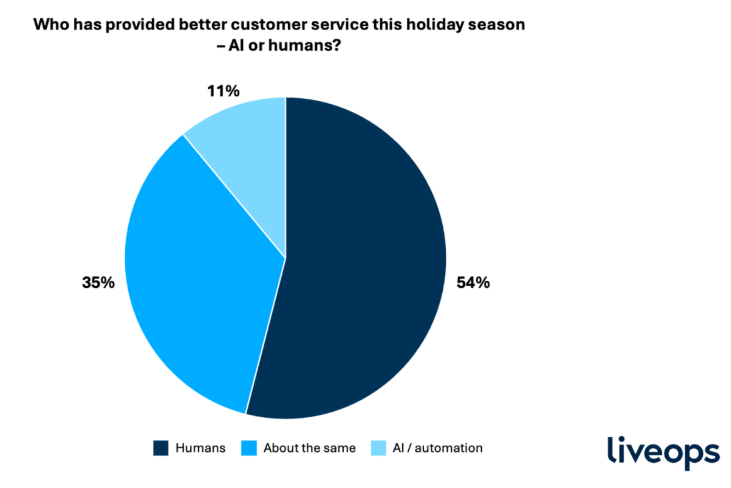
The 2025 holiday season was the first in which AI truly took over customer service at scale. Liveops found that nearly eight in ten shoppers interacted with automation during their journey. The result was faster service, but mixed feelings about quality and trust.
The Breakdown:
1. AI became the first point of contact - 78% of shoppers encountered AI, most often in chat and website help at 61%, followed by phone support at 39%. For many customers, automation was no longer optional; it was the default.
2. Speed improved but satisfaction lagged - 85% said AI made service faster, yet only 29% felt it clearly improved their overall experience. Faster replies helped, but they did not always solve the problem.
3. People still handle the hard moments - 54% said humans delivered better service, and 55% had to escalate AI interactions to a person. When issues involved emotion or complexity, customers wanted empathy, not scripts.
4. Transparency remains the weak spot - Only 22% said brands clearly disclosed AI use, even though 69% believe companies should always be upfront. Feeling misled, hurt trust more than the presence of AI itself.
AI is now expected in customer service, especially during peak seasons. But speed without empathy creates frustration, not loyalty. Brands that combine automation with clear disclosure and easy human handoffs will earn trust and stand out in 2026.
🚀Quick Hits
📦 Managing creators manually is a growth bottleneck. With Insense, one brief connects you to 68,500+ UGC creators who deliver raw and edited assets fast. Revolut scaled to 350+ assets with 140 creators, and Maty’s achieved 12× reach with TikTok Spark Ads. Book your free strategy call by Sept 19th to get $200 for your first campaign.
📌 Reports suggest OpenAI may pursue a Pinterest acquisition to secure real-time human data, boost shopping search, and strengthen ChatGPT’s ad and commerce capabilities as rivals lean on their own massive platforms.
🎯 Google Ads has upgraded Creator Partnerships with new search filters and centralized management tools, helping advertisers find YouTube creators faster and manage collaborations more efficiently across campaigns.
📱 New data shows mobile shoppers shifting from brand apps to text, RCS, and mobile wallets, with 78% now buying directly from SMS and 41% preferring to redeem offers via text over email or apps.
🛣️ A new U.K. survey shows 80% of consumers purchased after seeing an OOH ad, with 77% discovering new brands, proving outdoor media still drives real engagement and sales.
That’s a wrap for today! Tell us your thoughts about today's content as we line up more Shorts! And don’t hesitate to share this with someone who’d adore it. 🥰